What is galangal? What are its benefits and how does it differ from ginger?
- What is galangal?
- Galangal effects: what can you expect from it?
- Galangal vs. ginger: what is the difference between them?
- Is galangal better fresh, dried or in paste form?
- Where to buy galangal?
- Conclusion: a traditional plant with potential
- FAQ
What is galangal?
Galangal (Latin: Alpinia officinarum), sometimes referred to in Czech as ‘ ’ or ‘galgán’ , has been used in traditional Chinese medicine for thousands of years, most commonly to relieve pain, aid digestion or alleviate the symptoms of a cold.
It is a perennial tropical plant native to Southeast Asia. Today, it is known not only in traditional herbal medicine but also in modern gastronomy and is sold in several forms – fresh, dried, as an extract and as a paste.
Galangal effects: what can you expect from it?
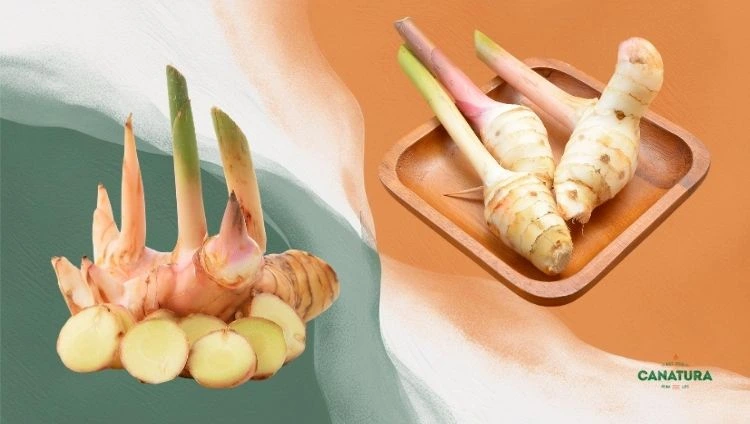
Galangal originates from China and is found primarily in southern regions (e.g. in the provinces of Fujian, Guangxi and Guangdong, or on the island of Hainan). Its therapeutic use was already recorded in ancient Chinese texts during the Han Dynasty.
This rhizome from the ginger family contains more than 300 bioactive compounds, including flavonoids, glycosides, phenylpropanoids, volatile oils and other compounds.
It is precisely this rich composition that explains why galangal has long been the subject of pharmacological research. Flavonoids and diarylheptanoids, for example, may have a range of pharmacological effects.
What do the studies say?
Studies to date suggest that crude extracts of galangal have a wide range of biological effects.
Research is being conducted, for example, into its anti-inflammatory potential, antibacterial activity and analgesic effects, as well as its impact on digestion and possible applications in cancer research. Some studies also focus on its effects on cognitive function.
Much of the current evidence is based solely on laboratory and preclinical studies. Further clinical studies will be needed to better understand the effects of galangal and its therapeutic potential.
Although the number of studies is currently limited, the flavonoid galangin has attracted considerable attention from scientists, particularly in relation to:
1. Aiding digestion
Galangal is often used as a supplement in the treatment of digestive tract disorders, such as heartburn and stomach ulcers.
In a 2011 study, researchers investigated the effect of galangal essential oil on stomach ulcers. The results suggested that, in mice, this extract could help reduce the incidence of stomach ulcers and increase the rate of their inhibition.
2. Pain relief
Galangal is also the subject of research for its anti-inflammatory and analgesic potential. Some studies suggest that the flavonoids contained in galangal may suppress inflammatory responses and reduce pain perception.
For example, their effect on acute inflammation and pain in mice induced by acetic acid and thermal stimulation was investigated. Researchers also focused on the flavonoid galangin, which they found can, to some extent, suppress airway inflammation in mice with asthma.

3. Effects on memory and cognitive function
Some preclinical studies suggest that the flavonoid galangin may have a positive effect on learning and memory. Research on mice investigated its potential neuroprotective effect in relation to Alzheimer’s disease.
However, these are currently results from laboratory and animal studies, which need to be verified in further research.
4. Anti-tumour effect
The flavonoid galangin has been described as having potential anti-tumour properties. However, its effect varies depending on the duration of exposure and concentration.
Scientists are also investigating whether it might one day play a role in the prevention of cancerous changes.
5. Effects on reproductive health and other benefits
A 2014 study suggested that galangal might affect sperm motility. Researchers investigated whether powder from the rhizome of Alpinia galanga increases the total number of motile sperm.
The study involved 70 adult men who took either tablets containing pomegranate fruit and long galangal rhizome extract, or a placebo, daily for three months. At the end of the trial, the total number of motile sperm had increased by 62% in participants taking the extract.
There have also been reports of galangal being used for haemorrhoids or abnormal menstruation. In India, its rhizome is commonly used for rheumatism, diabetes, neurodegenerative or inflammatory diseases.
Galangal vs. ginger: what is the difference between them?
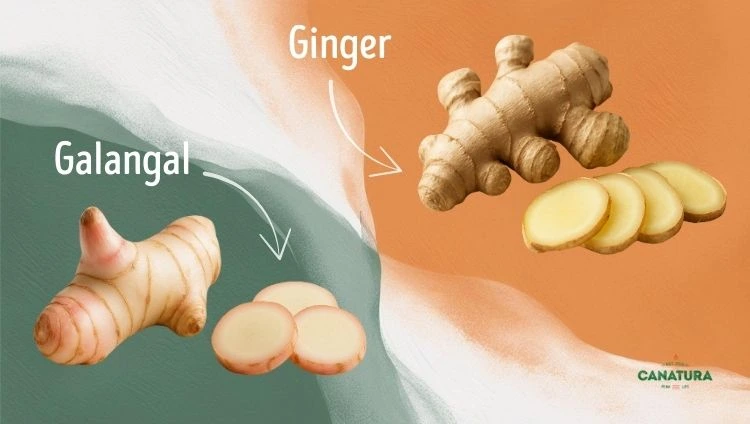
At first glance, galangal and ginger are similar, as both belong to the ginger family. However, they differ in taste and aroma.
Whilst ginger is juicier, spicy and slightly sweet, galangal stands out for its more pronounced, sharper, pungent and woodier flavour, often with subtle citrus notes.
Furthermore, ginger is more versatile and is commonly used in both savoury and sweet dishes, teas or lemonades. Galangal, on the other hand, is typical mainly of Asian cuisine, where it is added to soups, curry pastes, sauces and marinades.
Compared to ginger, galangal is also harder and more fibrous – so it is often simply boiled in a dish to impart its aroma.
And what about the effects?
Ginger is a more extensively studied plant than galangal, and there are also more clinical studies on it.
Some research, for example, suggests that ginger may have antioxidant, anti-inflammatory, hypoglycaemic and antiemetic effects. It also appears that it could be useful, for instance, for nausea and vomiting during pregnancy or for relieving menstrual cramps.
So far, research on galangal has mainly been limited to laboratory and preclinical studies. These suggest interesting therapeutic potential, though this has yet to be sufficiently demonstrated in humans. We have discussed this in more detail above .
Is galangal better fresh, dried or in paste form?
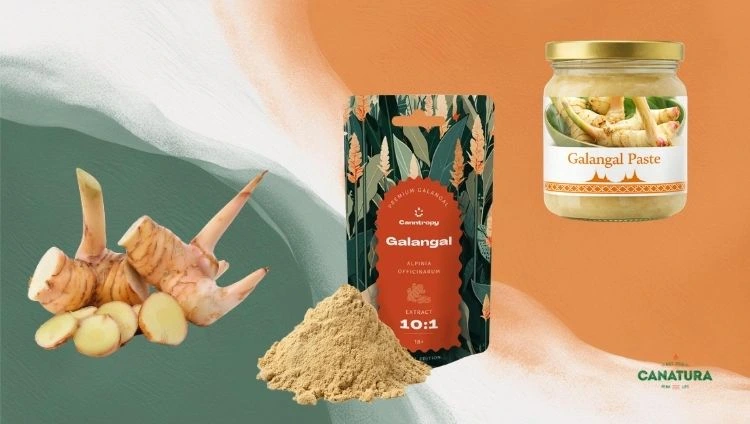
Galangal is available in several forms, each with its own specific uses:
Fresh galangal
Fresh galangal is the best choice if you want a distinctive and authentic flavour. It has the most intense aroma and works best in Asian dishes – for example, in Tom Kha Gai or Tom Yum soups, sauces and other dishes. It is also a key ingredient in curry pastes.
However, it is harder than ginger, so it is often sliced, crushed or simply cooked in the dish and removed before serving.
Galangal root
The term ‘galangal root’ usually refers to the rhizome of the plant itself, either fresh or dried.
Dried galangal in powder form is more practical to store and has a longer shelf life – though its flavour tends to be slightly less pronounced than that of the fresh variety.
You can often find galangal spice in specialist shops.
Galangal paste
Galangal paste is another ingredient suitable for cooking. It is ideal for curries, stir-fries, marinades and sauces, as it is easy to measure out and incorporate into dishes.
When choosing, however, it is a good idea to check the ingredients, as some pastes may contain other ingredients that are not entirely healthy.
Where to buy galangal?
These days, you can find galangal mainly in specialist online shops, in both fresh and dried forms.
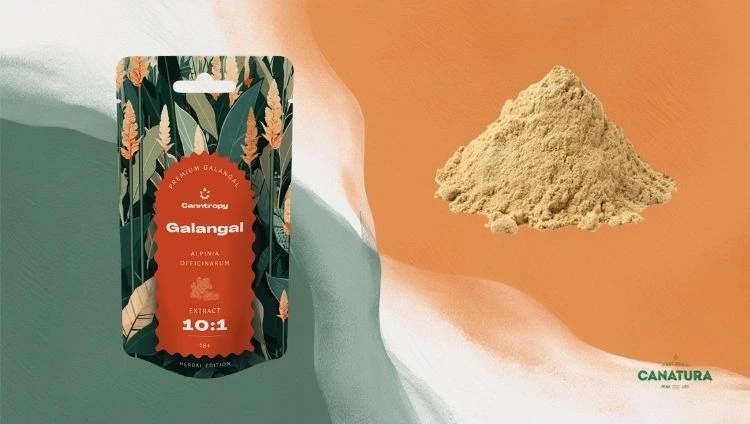
If you’re looking for a high-quality extract, we offer a 10:1 loose powder from Canntropy. We sell it in 10g, 25g and 100g packs.
Conclusion: a traditional plant with potential
Galangal has a long history in traditional Chinese medicine, most commonly associated with pain relief or aiding digestion. Research to date suggests that certain compounds found in galangal may have anti-inflammatory, antibacterial or analgesic potential.
It is available fresh, dried or as galangal paste. Galangal root is often used in Asian dishes, whilst galangal powder can serve as a good dietary supplement.
However, most of the knowledge gained about galangal so far comes from laboratory and preclinical studies. There is currently relatively little direct clinical evidence regarding the effects of galangal.
FAQ
1. What does galangal taste like?
At first glance, galangal may resemble ginger, as it belongs to the ginger family, but its flavour is different – it tends to have an aromatic, sharper and pungent taste.
2. What can be used as a substitute for galangal?
Galangal has a very distinctive flavour that combines spiciness, citrus notes and a slightly woody aroma – which is one reason why it is difficult to substitute.
However, if you don’t have any to hand, ginger can at least partially approximate it. Ginger is the most common substitute for galangal, although its flavour is juicier and sweeter.
Sources:
- Alpinia officinarum Hance: a comprehensive review of traditional uses, phytochemistry, pharmacokinetics and pharmacology
- An Extract of Pomegranate Fruit and Galangal Rhizome Increases the Numbers of Motile Sperm: A Prospective, Randomised, Controlled, Double-Blinded Trial
- Galangin alleviates learning and memory impairments in APP/PS1 double-transgenic mice by regulating the Akt/MEF2D/Beclin-1 signalling pathway
- Galangal, the multipotent super spice: A comprehensive review
- https://www.nccih.nih.gov/health/ginger
- Pharmacological properties of ginger (Zingiber officinale): what do meta-analyses say? A systematic review
Author: Lucie Schmidtová
Photo: AI
“All information provided on this website, as well as information provided through this website, is for educational purposes only. None of the information contained herein is intended to be a substitute for a medical diagnosis and should not be considered medical advice or recommended treatment. This website does not endorse, condones or advocate the licit or illicit use of narcotic drugs or psychotropic substances or the commission of any other illegal activity. For more information, please see our Disclaimer .”