What do marshmallow and marshmallow sweets have in common?
- What is marshmallow
- From medicine to sweet
- Legendary effects: What does science say?
- Back to basics
- Conclusion: Tradition backed by modern research
- FAQ
What is marshmallow?
Marshmallow, Latin name Althaea officinalis, is a perennial herb that grows mainly in Europe and Western Asia. It is found in damp areas, particularly around rivers.
It grows to a height of up to 180 cm, has delicate pink flowers and velvety leaves and stems. However, it is the root that is particularly prized, as it contains high levels of so-called mucilaginous polysaccharides and starches.
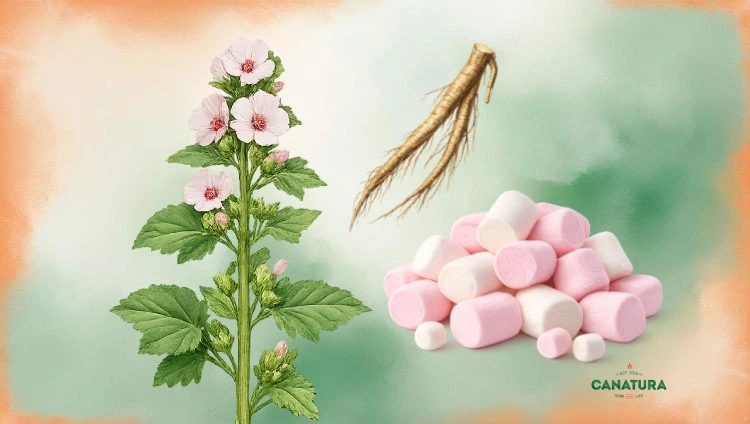
These polysaccharides are long chains of sugar units that have a unique property — when they come into contact with water, they do not simply dissolve like ordinary sugar, but absorb the water, swell and form a gel-like solution.
This has been used in medicine since ancient times — topically:
- on irritated and reddened skin
- for insect bites
- for blisters
- for skin conditions
- for minor injuries and burns
Internally, the solution was used for inflammation of the respiratory tract, urinary tract and for intestinal problems. It was used by the ancient Egyptians and Greeks.
In medieval Europe, the plant was commonly grown in monastery gardens and in the countryside, and its properties were utilised by both rulers and ordinary peasants.
From medicine to sweet
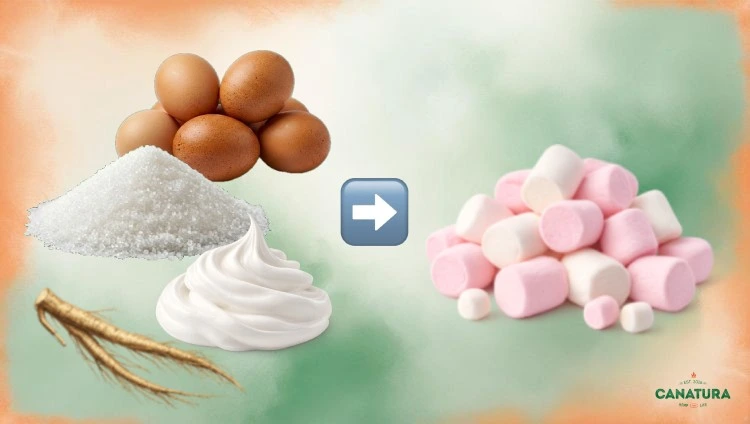
The similarity between the plant’s name and the popular marshmallow sweets is no coincidence. As early as in ancient Egypt, the first version of this sweet was made from marshmallow — the plant’s root was boiled and the resulting slimy mass was mixed with honey. The result was a soft, chewy sweet enjoyed only by the wealthiest.
However, marshmallows as we know them today were not produced until the 19th century in France. French confectioners made what was known as pâte de guimauve (marshmallow cream) by hand from:
- root extract
- sugar
- whipped egg white
Today’s marshmallow sweets, however, have very little in common with the original recipe. With the advent of industrial production, a fundamental change took place. Because processing the plant extract was laborious, it was replaced with gelatine.
And although the sweet still bears its original name, you won’t find marshmallow root in it today.
Legendary effects: What science says
What are the medicinal effects of marshmallow? As already mentioned, in traditional herbalism, marshmallow was believed to have the ability to:
- moisturise and soothe irritated skin
- moisturise mucous membranes and relieve irritation in cases of respiratory tract problems
- relieve discomfort associated with urinary tract inflammation
- act on the intestines, harmonising digestion
- contribute to the body’s overall balance
But what do modern studies say about the plant?
An EMA (European Medicines Agency) report states that the plant’s root may contain up to over 10% mucilaginous polysaccharides, 25–35% starch, and 10% sucrose, whilst the flavonoid content is only in the order of tenths of a percent.
Laboratory studies have shown that polysaccharides from the proskurník plant are able to attach themselves to the surface of cells and form a bioadhesive layer. They can therefore:
- increase cell viability
- influence gene expression
- support cellular activity
Animal studies have shown that both the extract and the isolated polysaccharides were able to reduce the intensity and frequency of coughing without dilating the bronchi, as other medicines do. Research to date has suggested that the effect may be related to the involvement of 5-HT2 receptors, which are serotonin receptors. This could therefore involve neurological regulation of the cough reflex.

Clinical studies in humans are limited. A 4-week study involving 60 participants suffering from cough caused by ACE inhibitors showed that the group taking coltsfoot extract experienced a statistically significant reduction in cough intensity compared to the placebo group.
However, the sample size was too small, the type of cough studied was specific, and the composition of the extract used was not described in detail, so the research does not provide conclusive evidence of the plant’s efficacy.
Studies to date suggest that the action of marshmallow root lies primarily in its ability to form a protective layer on the surface of mucous membranes and in its interaction with the cellular environment. The results do not contradict traditional use; on the contrary, they provide a biological explanation for it.
At the same time, no adverse effects have been identified. However, the extract itself is not a clinically validated medicinal product.
Modern medicine follows tradition, and even today, marshmallow extract, in combination with other active ingredients, is used in the manufacture of a whole range of modern registered medicines, particularly cough syrups.
Back to basics
With the growing interest in alternative medicine in modern society, marshmallow is gaining attention once again.
Cultivating marshmallow is not difficult, but it requires specific conditions — it needs moist soil and plenty of sun. The root is harvested only after several years, when it is fully mature. People therefore prefer to buy marshmallow root extract.
Conclusion: Tradition backed by modern research
Marshmallow is a common herb found in Europe and Western Asia. Since ancient times, its root has been used primarily to prepare a gel-like solution. It was from this that the first marshmallow sweets began to be produced in the 19th century; they have retained their name to this day, even though they no longer contain the plant extract.
The reputed effects of marshmallow root are no longer merely speculative; science can now explain them — they lie primarily in the physical properties of its polysaccharides. Although new research does not provide conclusive clinical evidence of its medicinal effects, it shows that its traditional use has a biological basis, and therefore marshmallow root extract has found its place in modern medicine.
It is precisely this combination of tradition and science that explains why the extract is regaining popularity among the general public, who are showing a growing interest in natural medicine.
FAQ
1. Can goldenrod be grown at home in the garden?
Yes. It just needs moist soil and plenty of sun. If conditions are right, it thrives very well.
2. How long does it take before the root can be harvested?
Yarrow is a perennial plant; it takes root in the first year and reaches full maturity in 2–3 years, at which point it can be harvested
3. How does the extract differ from the dried herb?
The extract is more concentrated. For example, an extract labelled 10:1 means that ten times as much raw material was used in its production, so that for the same volume, it contains up to ten times more active compounds than the dried herb.
4. Does marshmallow have any taste?
Yes, its flavour is very mild, slightly sweet. It does not contain strong aromatic compounds, so it is not bitter like some other herbs.
5. What is the connection between the herb and marshmallows?
The original recipe for making these popular sweets contained an extract from the plant from which they took their name. However, modern marshmallows no longer contain it.
Sources:
- Marshmallow (Althaea officinalis): Benefits, Safety, Uses | Herbal Reality
- Assessment report on Althaea officinalis L., radix
Author: Natálie Kubíčková
Photo: AI
“All information provided on this website, as well as information provided through this website, is for educational purposes only. None of the information contained herein is intended to be a substitute for a medical diagnosis and should not be considered medical advice or recommended treatment. This website does not endorse, condones or advocate the licit or illicit use of narcotic drugs or psychotropic substances or the commission of any other illegal activity. For more information, please see our Disclaimer .”