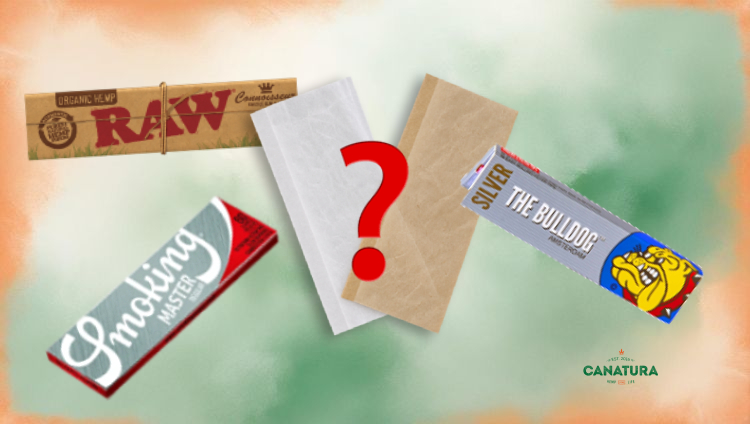
Bleached vs. unbleached rolling papers: What’s the difference and which should you choose?
- What is the difference between bleached and unbleached rolling papers?
- How are rolling papers bleached?
- How bleaching affects taste and burning
- Which rolling papers should you choose?
- Conclusion: Are bleached or unbleached rolling papers better?
- FAQ
What is the difference between bleached and unbleached rolling papers?
Rolling papers are made from a thin layer of plant fibres. Raw materials include, for example wood pulp, flax, hemp and other plant materials. The processed fibres are broken down, mixed with water and formed into a sheet of paper.
The difference between bleached and unbleached papers is whether the fibres undergo a bleaching process. Depending on the technology used, bleaching can involve different chemical methods.
Many people assume that rolling papers are always bleached with chlorine, a process that can produce toxic substances such as certain dioxins and furans. In the modern paper industry the main technologies used do not involve elemental chlorine. These include bleaching with chlorine dioxide or processes using oxygen, ozone or hydrogen peroxide.
Unbleached rolling papers do not undergo bleaching, but this does not automatically mean they pose fewer health risks than bleached alternatives. The natural origin of a material does not, in itself, guarantee its safety. Furthermore, even unbleached fibres must be processed, cleaned and formed during production, and adhesives, mineral fillers or other processing additives may be used.
It follows that the colour of rolling papers alone is not a reliable indicator of their composition, quality or the health risks associated with smoking.
How are rolling papers bleached?
The aim of bleaching is to achieve the desired brightness of the fibres by removing or chemically modifying the substances responsible for their colour, such as lignin.
In the past, the paper industry used elemental chlorine (Cl₂) for bleaching. Its reactions with organic substances could produce toxic by-products, including certain dioxins and furans.
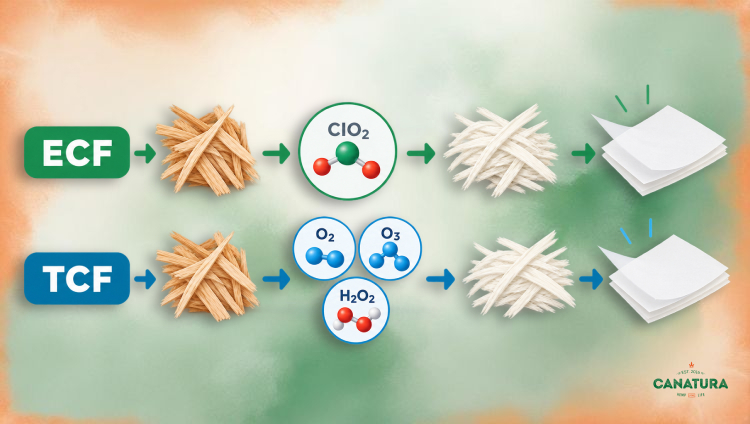
Modern paper manufacturing therefore favours methods that are much more considerate of human health and the environment, such as ECF and TCF technologies.
- ECF (Elemental Chlorine-Free): The world’s most widely used method for bleaching chemical pulp completely eliminates elemental chlorine (Cl₂). Instead, it uses chlorine compounds, most commonly chlorine dioxide (ClO₂). Compared with historical elemental chlorine bleaching, the ECF method significantly reduces the formation of certain toxic dioxins and furans.
- TCF (Totally Chlorine-Free): In TCF bleaching, no chlorine-based bleaching agents are used. Instead, oxygen (O₂), ozone (O₃) or hydrogen peroxide (H₂O₂), for example, are used. As a result, the bleaching process does not produce chlorinated organic substances as a result of using chlorine-based bleaching agents. One potential disadvantage is slightly higher production costs. Compared with ECF, TCF may also achieve a lower degree of whiteness, although this depends on the particular manufacturing process.
How bleaching affects taste and burning
Some smokers prefer unbleached rolling papers because they consider them more neutral in taste. Others notice no significant difference between bleached and unbleached varieties.
There is currently insufficient direct scientific evidence that bleaching itself causes a significant difference in taste. The material used, additives and paper thickness may have a greater influence on flavour.
When choosing papers, it makes more sense to compare specific product specifications and composition than to decide based solely on the colour of the paper.
Burn rate also depends on several factors, primarily paper weight, structure and porosity, as well as any additives used to regulate burning.
Which rolling papers should you choose?
Your choice of rolling papers can affect the entire experience because, when smoking, you inhale not only tobacco smoke but also the by-products of burning paper and any additives it contains.
If you prefer the classic white appearance, there is no reason to avoid bleached rolling papers. Modern bleaching methods significantly reduce the formation of certain undesirable substances associated with historical bleaching processes. Bleaching itself also does not necessarily make a difference to the taste or burn rate of the papers.
If, for any reason, you prefer papers made without a bleaching process and like their natural brown appearance, choose unbleached rolling papers.
Other factors to consider when choosing
As mentioned above, bleaching is not the only factor affecting the properties, quality and safety of rolling papers. Other important factors include:
- Material and raw materials: Rolling papers are made from materials such as wood pulp, hemp or flax. The fibres used can affect taste, burning, strength, texture and other properties of the paper.
- Paper weight and thickness: Extra-thin papers generally have a lower basis weight, meaning that the same surface area contains less material that could produce ash and combustion by-products.
- Type and quality of the adhesive strip: The material and quality of the adhesive strip primarily affect how reliably the paper stays sealed after rolling.
- Other added chemical ingredients: Rolling papers may contain additives that adjust their burn rate or other properties. Some may also affect the amount of combustion by-products produced.
A 2019 study, published in the journal Environmental Research, analysed 257 samples of tobacco, rolling papers and filters. It examined their chemical element content and calculated potential intake for a model heavy smoker.
The results suggested that bleached and flavoured papers may contribute to higher levels of some of the elements studied. In extreme comparisons between different types of cigarettes, differences in theoretically estimated exposure reached up to 35–40 times.
However, rather than simply highlighting differences between bleached and unbleached papers, the study primarily points to the importance of overall material composition.
What to choose from bleached and unbleached rolling papers
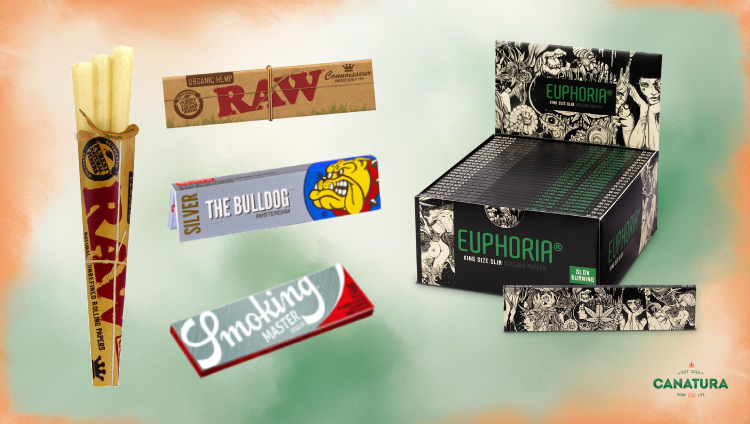
Among the traditional brands of rolling papers is the Spanish brand Smoking, whose history dates back to the 19th century. Its range includes white rolling papers in various sizes and designs, such as Regular and King Size. The brand also offers unbleached options and filters.
Both bleached and unbleached rolling papers are also offered by the Dutch brand The Bulldog. Its range includes classic white papers from the Silver series and brown Unbleached varieties, filters and pre-rolled cones.
The unbleached rolling papers are a particular focus of the brand RAW, which offers Classic and Organic Hemp ranges. According to the manufacturer, the papers contain no added burn-control substances, and the adhesive is made from natural acacia gum sourced from Ethiopia and Senegal.
The manufacturer also states that no genetically modified organisms or animal-derived ingredients are used in production, making the papers suitable for vegans. RAW offers papers in various sizes, as well as filters and cones.
💡 Still not sure which to choose? Read: Our selection of the best rolling papers: 9 brands worth checking out
Conclusion: Are bleached or unbleached rolling papers better?
Neither option is clearly better. If you prefer the classic white appearance, you can choose bleached papers. If you prefer a natural brown appearance and want to avoid the bleaching process during production, unbleached papers may be a better fit for you.
If taste or burn rate is your main priority, focus instead on specific paper properties, such as the material, basis weight and any additives. Colour alone tells you nothing about these properties.
Whether you choose bleached or unbleached papers, remember that inhaling smoke always carries health risks.
FAQ
1. Do unbleached rolling papers burn more slowly than bleached ones?
Not necessarily. Burn rate depends on the composition, thickness, porosity and other properties of the paper.
2. Are bleached rolling papers safe?
Modern methods of bleaching without elemental chlorine significantly reduce the formation of certain toxic substances associated with historical chlorine bleaching. However, this does not automatically guarantee that the finished rolling paper is safe.
3. Are unbleached rolling papers healthier?
This has not been proven. There is insufficient direct scientific evidence that using unbleached rolling papers involves lower health risks than using bleached ones. The absence of bleaching alone does not guarantee greater safety.
4. Are hemp rolling papers always unbleached?
No, hemp rolling papers can also be bleached.
5. Are brown rolling papers natural?
Not automatically. A brown colour does not guarantee an entirely natural composition. Even unbleached papers can contain chemical additives that may be potentially harmful. To check the composition, you need to refer to information from the specific manufacturer.
6. Are bleached or unbleached cones better?
Pre-rolled cones are also available in bleached and unbleached versions. However, unbleached paper does not automatically mean higher quality or lower health risks, even for cones.
Sources:
- https://pubmed.ncbi.nlm.nih.gov/31344622/
- https://publications.jrc.ec.europa.eu/repository/bitstream/111111111/55331/final_tr_papr_products_4_pubsy_13.02.2019.pdf
- https://research.aalto.fi/en/publications/techno-economic-analysis-of-ecf-bleaching-and-tcf-bleaching-for-a/
- https://bioresources.cnr.ncsu.edu/resources/environmentally-friendly-bleaching-on-bamboo-neosinocalamus-kraft-pulp-cooked-by-displacement-digester-system/
- https://www.coresta.org/abstracts/impact-cigarette-paper-parameters-smoke-yields-cigarettes-different-circumferences-31894
- https://pubmed.ncbi.nlm.nih.gov/30513508/
Author: Natálie Kubíčková
Photo: AI
“All information provided on this website, as well as information made available through this website, is for educational purposes only. None of the information presented here is intended to replace a medical diagnosis, nor should it be considered medical advice or a recommended treatment. This website does not promote, endorse or advocate the legal or illegal use of narcotic or psychotropic substances or any other illegal activity. For more information, please see our Disclaimer.”
