What is T9HC? Effects, legality and safety – everything we actually know about this cannabinoid
- What is T9HC?
- Is T9HC legal?
- T9HC effects: What does science say?
- Side effects of T9HC
- T9HC vs. THC
- T9HC vs. HHC
- Conclusion: An unexplored cannabinoid with unclear effects
- FAQ
Why are there still so many unanswered questions surrounding T9HC? Find out what is actually known about this newer cannabinoid and what remains unclear. We’ve looked at its potential effects, legality, safety and how it compares to THC and HHC.
What is T9HC?
T9HC is the name given to a synthetic cannabinoid produced in a laboratory, about which very little information is currently available.
Unlike well-known cannabinoids such as CBD or THC, neither the chemical structure nor the properties of T9HC have yet been clearly described.

The exact T9HC meaning is not known based on the currently available sources. Although the name resembles Δ9-THC and appears to refer to the tetrahydrocannabinol (THC) group, it is unclear whether it is related to the chemical structure of this substance.
Is T9HC legal?
The legal status of T9HC is currently unclear and may vary from country to country. In some countries, products containing T9HC may not be classified as prohibited substances, but this does not automatically mean that their sale is permitted.
Furthermore, legislation concerning new cannabinoids can change relatively quickly. As a result, T9HC often operates in a legal grey area.
Nevertheless, T9HC flowers, T9HC gummies, T9HC vape pen or T9HC cartridge may appear on some markets.
T9HC effects: What does science say?
According to available information, T9HC may belong to the group of tetrahydrocannabinols; however, its exact chemical structure has not been confirmed by scientific studies. Information about the origin, properties and T9HC cannabinoid effects is still very limited.
It is assumed that, like other psychoactive cannabinoids, T9HC may interact with the endocannabinoid system, specifically the CB1 and CB2 receptors. The CB1 receptor is involved in regulating a range of bodily functions (such as appetite, mood, memory and pain perception), whilst the CB2 receptor is important for the immune system.
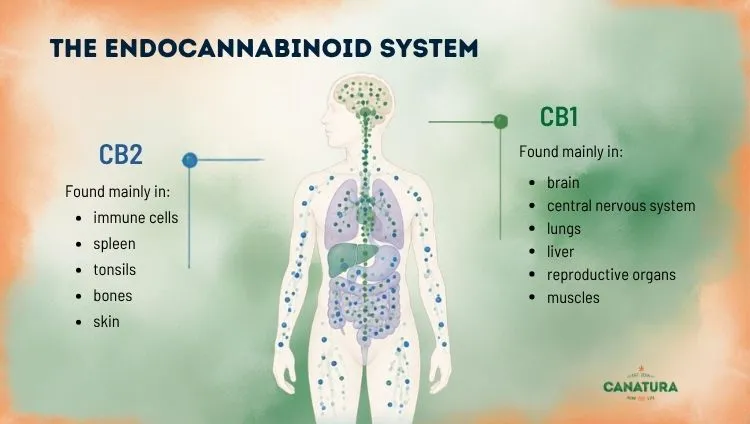
However, no studies are yet available that describe how the cannabinoid T9HC interacts with CB1 or CB2 receptors. It is therefore not possible to say whether, and if so how, its effects differ from those of Δ9-THC.
Side effects of T9HC
At present, we do not know the side effects of T9HC. However, if T9HC acts in a similar way to the psychoactive cannabinoid THC, it can be assumed that similar adverse effects may occur, such as:
- euphoria,
- dry mouth,
- red eyes,
- dizziness,
- drowsiness or tiredness,
- changes in heart rate,
- impaired concentration,
- anxiety or paranoia.
T9HC vs. THC
Although the designation T9HC may suggest a connection with the tetrahydrocannabinol (THC) group, any similarity to THC has not yet been investigated.
It is therefore not possible to compare T9HC with THC, nor to determine how the two substances differ in terms of chemical structure, potency or safety.
The only thing that can be said is that both T9HC and THC are psychoactive cannabinoids. Unlike THC, which is a natural cannabinoid occurring naturally in the cannabis plant, T9HC is produced in a laboratory and is therefore synthetic.
T9HC vs. HHC
Like T9HC, HHC is also classified as a psychoactive cannabinoid. Whilst both are among the less well-researched cannabinoids, HHC has attracted greater attention from scientists.
T9HC is produced in a laboratory, whilst HHC occurs naturally in cannabis, albeit only in trace amounts. For this reason, HHC for commercial products is also usually produced in a laboratory.

For more information on HHC, see our article What is HHC? Effects, legality, safety and a comparison of HHC vs. THC’.
Conclusion: An unexplored cannabinoid with unclear effects
T9HC is one of the newer cannabinoids, about which only a very limited amount of information is currently available. Its chemical structure, effects and safety have not yet been sufficiently researched.
Until further scientific studies are available, a number of unanswered questions will remain regarding T9HC.
FAQ
1. Is T9HC psychoactive?
T9HC is considered to be a psychoactive cannabinoid. However, no studies describing its psychoactive effects are available as yet.
2. Is T9HC natural or synthetic?
According to the available information, T9HC is a synthetic cannabinoid, i.e. produced using laboratory processes; however, its exact origin and chemical structure have not yet been fully clarified.
We have covered synthetic cannabinoids in more detail in the article What are synthetic cannabinoids and why are they dangerous?
3. Is T9HC stronger than THC?
At present, it is not possible to say. There are no scientific studies comparing the potency of T9HC and Δ9-THC. Any claims regarding greater or lesser potency may be based on information from manufacturers or users’ experiences.
4. Will T9HC show up in a drug test?
We do not know how T9HC affects the results of drug tests. We can only assume that, as with other psychoactive cannabinoids, a positive result cannot be ruled out.
5. How long does T9HC remain in the blood?
The exact length of time for which T9HC can be detected in the blood has not yet been studied. For other cannabinoids, this period is influenced by a number of factors, such as dose, frequency and method of use, metabolism or body weight.
However, we do know how it works with THC, for example. You can find out more in our article How long does THC (not only) stay in the blood and what factors influence this? Overview of measurement methods’.
Photo: AI, Canva
“All information provided on this website, as well as information provided through this website, is for educational purposes only. None of the information contained herein is intended to be a substitute for a medical diagnosis and should not be considered medical advice or recommended treatment. This website does not endorse, condones or advocate the licit or illicit use of narcotic drugs or psychotropic substances or the commission of any other illegal activity. For more information, please see our Disclaimer .”