What is reishi good for and why is it called the “mushroom of immortality”?
- What is reishi?
- A symbol of longevity, power and prosperity
- Where does the reishi mushroom grow?
- How is reishi extract obtained?
- What does reishi mushroom do and what is it good for?
- What does reishi powder look and taste like?
- Available products with reishi
- Conclusion
- FAQ
What is reishi?
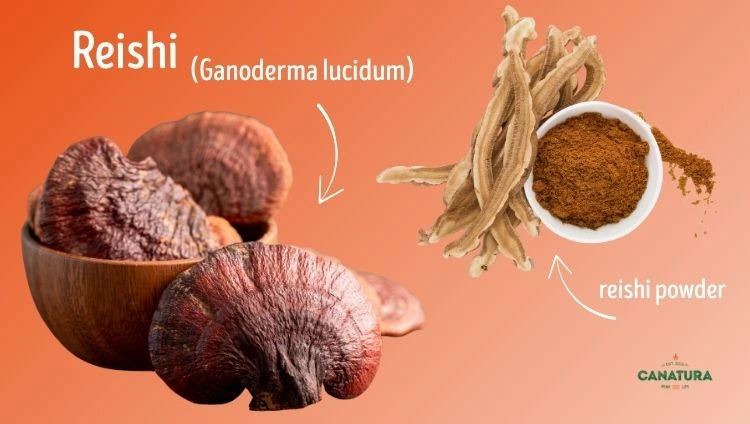
Reishi (Ganoderma lucidum, from the Greek ganos = shiny, derma = skin) is a wood-decaying fungus that belongs to the medicinal (functional) fungi – i.e. types of fungi that contain bioactive substances that promote health.
It has been used in traditional medicine for thousands of years – in China it is known as ling-zhi, and in Japan as reishi. Today it is popular all over the world and a number of studies point to its possible therapeutic effects.
A symbol of longevity, power and prosperity
In Asia, reishi is nicknamed the “mushroom of immortality”, which is suggested by its Chinese name lingzhi (ling = spiritual, sacred, zhi = mushroom). It is therefore considered a “herb of spiritual power”, a symbol of success, prosperity and longevity, and is highly valued for maintaining good physical and mental health.
According to Taoist myths, lingzhi grows on the “three islands of bliss” off the Chinese coast (Penglai, Fangzhang and Yingzhou). However, its reputation as a panacea probably stems from the fact that it is rare and is used only by the rich and privileged members of Chinese society.
The symbol of lingzhi also found its way into court decorations – for example, the head of the Chinese ruyi sceptre resembles the shape of this mushroom of longevity.
Where does the reishi mushroom grow?
Stumps, roots and oak trunks are the most common places where reishi mushrooms grow. However, due to high demand, it is also cultivated artificially on wooden logs or a substrate of sawdust and straw, or by cultivating mycelium in bioreactors.
The main producers of reishi mushrooms are China, Korea, Vietnam, Thailand and Taiwan. Red reishi is popular in Japan, while black reishi is popular in southern China.
How is reishi extract obtained?
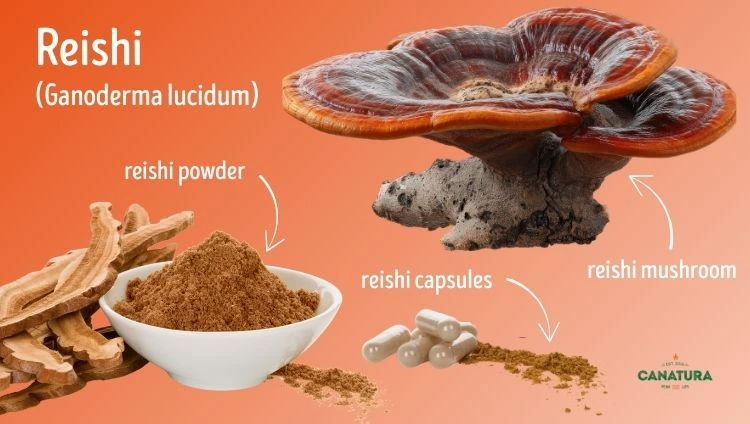
After harvesting, reishi is cleaned, dried and then ground into a fine powder, which is then sold or put into capsules, cosmetics, coffee or syrups.
Various parts of the mushroom are used to make reishi extract products, including the fruiting body, mycelium and spores.
What does the reishi mushroom do and what is it good for?
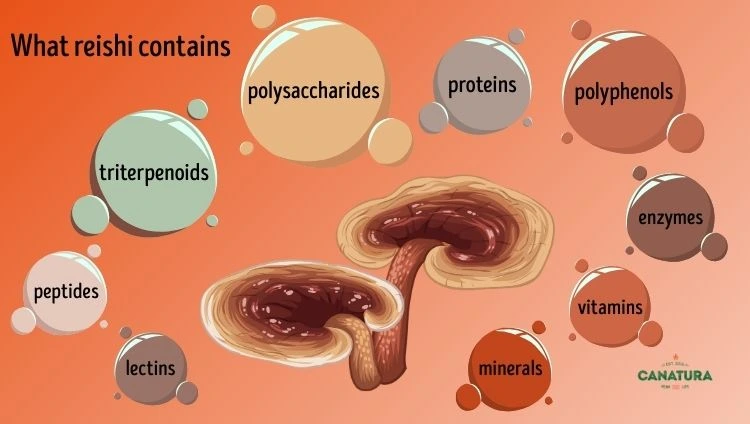
Reishi contains more than 400 different biologically active substances, the most important of which are polysaccharides and triterpenoids. It also contains polyphenols, proteins, peptides, lectins, enzymes, vitamins and minerals.
Ganoderic acids (GA) are an important type of triterpenoids, which are credited with immunological, anti-tumour, antioxidant and anti-inflammatory effects.
Most studies investigating the effects of reishi mushrooms are conducted primarily on cellular organisms or animals – there is little clinical research on humans to date. Even so, current research shows us what reishi mushrooms are good for:
1. Immune support
Medicinal mushrooms contain a number of bioactive compounds with immunomodulatory effects, such as polysaccharides, terpenoids, phenols and proteins. Polysaccharides make up 80% of the cell wall of mushrooms, with about half of that being β-glucans.
β-glucans from mushrooms are powerful stimulators of the immune system. A 2019 laboratory study analysed nine extracts from reishi, shiitake and maitake mushrooms and monitored how polysaccharides (mainly β-glucans) affect immune cells.
Most of the tested extracts and their combinations showed a synergistic immunostimulatory effect on most cytokines in human macrophages – however, the mixture of mushroom extracts was able to increase the production of substances important for the immune response more than the individual extracts in laboratory conditions.

A 2023 study published in the scientific journal Scientific Reports examined the effects of reishi mushroom powder on Labeo rohita fish.
Fish that were fed a diet containing 10% reishi powder for 4 months had better immune indicators, were more resistant to bacterial infections and were in better overall condition.
👉 Tip: Mushrooms do not always have to be used to promote a healthy lifestyle; muscimol is a good example of this. You can learn more about it in the article What is muscimol? Effects, user experiences, risks and overdose (poisoning).
2. Antioxidant and anti-inflammatory effects
In 2009, a study was published in the journal Scientia Pharmaceutica in which scientists tested reishi from tropical southern India on mice with chronic inflammation. The chloroform extract from this mushroom showed the ability to capture free radicals, and its anti-inflammatory activity was comparable to diclofenac.
It is important for the human body to limit the formation and spread of free radicals, thereby preventing oxidative stress – which is why it is advisable to take antioxidants. According to a study published in Food Research International, reishi extract exhibits antioxidant activity.
3. Positive effect on the skin
A 2022 study examined mushroom extracts (including reishi) as ingredients in washing and shower gels. The results showed that gels with mushroom extracts were gentler on the skin and reduced the formation of free radicals.
In addition, they also had a positive effect on skin pH and hydration while reducing TEWL, i.e. the amount of water that evaporates from the skin.
4. Potential anti-tumour effects
A 2016 study examined five studies conducted on 373 patients in China and found that those who took reishi extract along with chemotherapy or radiotherapy responded 1.27 times better to treatment than those who did not take reishi.
Patients taking the extract also experienced an improvement in their quality of life. However, when reishi was administered alone, no effect on tumour reduction was demonstrated.
A 2012 study conducted on mice with severe immunodeficiency (= weakened ability of the immune system to effectively fight infections and other diseases) showed that administering reishi extract for 13 weeks reduced tumour growth and weight by approximately 50%.
What does reishi powder look and taste like?
The mushroom has a distinctly bitter taste, which is related to its triterpenoid content. However, this is often lost during artificial cultivation.
Reishi powder is usually finely ground and has a brown to reddish-brown colour.
Available products with reishi
Reishi can now be found in a wide range of forms – from capsules and drops to teas, coffee, syrups and cosmetics.
Various parts of the mushroom are used to make these products – the fruiting body, mycelium and spores.
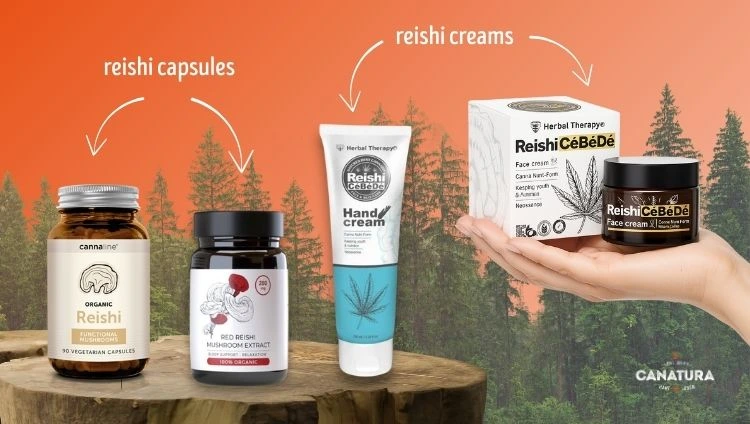
Reishi capsules
The most common and convenient form of reishi is capsules.
You can buy pure reishi extracts as well as combinations with other medicinal mushrooms such as chaga, cordyceps, lion’s mane, maitake or shiitake.
👉 Tip: There are other functional mushrooms that can support your health. We have written more about them in the article Medicinal mushrooms.
Cosmetics with reishi
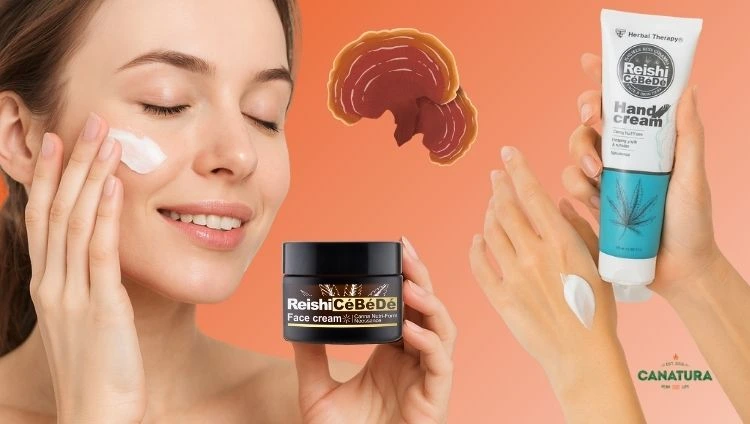
Reishi is no longer found only as a dietary supplement – it is also increasingly appearing in cosmetics.
You will find various face creams and hand creams containing reishi on the market, which aim to nourish, moisturise and support the natural regeneration of the skin.
👉 Tip: Want to explore other natural products? Check out our other articles on herbal supplements.
Conclusion
Reishi has been used in Asia for thousands of years. It is often called the “mushroom of immortality” because it is rich in bioactive substances, especially polysaccharides and triterpenoids, which can have a positive effect on immunity, inflammation suppression and better skin hydration. Its potential anti-tumour effects are also promising.
Reishi extract is available as a powder or capsule and is also added to foods, beverages and cosmetics. It can be a useful addition to a healthy lifestyle, but it is not a substitute for a varied diet or professional care.
FAQ
1. How to take reishi?
Reishi can be taken in capsule form or as a powder that can be easily mixed into food or drinks.
Ready-made products containing reishi extract (such as coffee, tea or syrup) are also available.
2. When should reishi be taken?
It is usually recommended to take reishi on an empty stomach at least 30 minutes before a meal and wash it down with water. If you have a sensitive stomach, it may be better for you to take reishi about 60 minutes after a meal.
The time of day when you take reishi also depends on the effects you expect:
- morning use: can help kick-start the body for a new day and boost immunity
- Evening use: can help calm the body and improve sleep quality
Pregnant and breastfeeding women, as well as people taking medication, should consult their doctor about taking reishi.
3. How much reishi per day?
The daily dose of reishi depends on a person’s age and weight, the reason for use, and the type and strength of the extract. In general, however, it can be said that:
- 1–3 grams of reishi powder per day,
- reishi capsules 1–3 per day,
- reishi tea 1–2 cups per day.
Always follow the manufacturer’s instructions for the specific product or the recommendations of a specialist.
4. How long should reishi be taken?
The duration of reishi use depends on individual needs, health status and the recommendations of a specialist or manufacturer. There is no single “correct” duration for everyone, as it is influenced by several factors.
It is said that reishi can be used continuously for a short period of time, but after 3 months at the latest, it is necessary to take a break for about a week or two. For a longer-term regimen, a schedule of 5 days of use + 2 days of break is recommended.
5. How long does it take for reishi to take effect?
The speed at which the effects kick in is individual; for some people, they may appear within a few days to weeks, for others it may take months.
Sources:
- Ganoderma lucidum and modern medicine
- Medicinal Mushrooms: Their Bioactive Components, Nutritional Value and Application in Functional Food Production—A Review
- Herbal Medicine: Biomolecular and Clinical Aspects. 2nd edition
- The Pharmacological Effects of Triterpenoids from Ganoderma lucidum and the Regulation of Its Biosynthesis
- Anti-Tumour Effects of Ganoderma lucidum (Reishi) in Inflammatory Breast Cancer in In Vivo and In Vitro Models
- Ganoderma lucidum (Lingzhi or Reishi): A Medicinal Mushroom
- Ruyi Scepter with Motifs of Longevity
- G. lucidum (Reishi mushroom) for cancer treatment
- The Pharmacological Effects of Triterpenoids from Ganoderma lucidum and the Regulation of Its Biosynthesis
- Immuno-physiological effects of dietary reishi mushroom powder as a source of beta-glucan on Rohu, Labeo rohita challenged with Aeromonas veronii
- Antioxidative and Antiinflammatory Activities of the Chloroform Extract of Ganoderma lucidum Found in South India
- Assessment of Cosmetic Properties and Safety of Use of Model Washing Gels with Reishi, Maitake and Lion’s Mane Extracts
- Synergistic immuno-modulatory activity in human macrophages of a medicinal mushroom formulation consisting of Reishi, Shiitake and Maitake
- Fruiting body, spores and in vitro produced mycelium of Ganoderma lucidum from Northeast Portugal: A comparative study of the antioxidant potential of phenolic and polysaccharidic extracts
Author: Lucie Schmidtová
Photo: AI
“All information provided on this website, as well as the information provided through this website, is for educational purposes only. None of the information contained herein is intended as a substitute for medical diagnosis and such information is not to be considered medical advice or recommended treatment. This website does not promote, endorse or advocate the legal or illegal use of narcotic drugs or psychotropic substances or the commission of any other illegal activity. Please see our Disclaimer for further information.”

