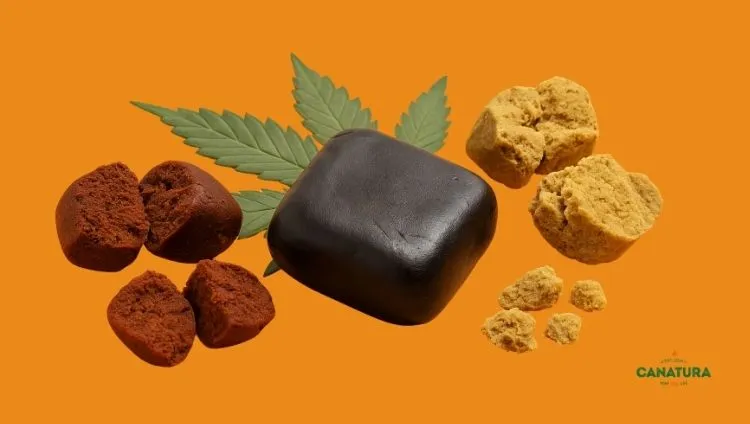
Traditional types of hashish: Lebanon, Afghanistan, Morocco (Ketama) and Pakistan
This article is not suitable for persons under the age of 18. The content is purely educational and informational in nature. It describes the history, production, effects and traditional uses of hashish. Under no circumstances is it a guide to use or a recommendation to break the law. All information is for educational purposes only and does not promote the illegal use of psychotropic substances. We remind you that in most European countries, only cannabis and products containing up to 0.3% THC (up to 1% in the Czech Republic) are legal.
What is hash?
Hashish (hash, hashish) is a traditional cannabis product obtained from the resin (trichomes) of the cannabis plant. Trichomes contain the highest concentration of cannabinoids and aromatic substances, which is why hashish is notable for its potency, distinctive aroma and specific effects.
It is produced using various methods – from dry sifting and pressing to hand rubbing of live plants (charas) to modern extraction processes. Each region of the world has given rise to unique types of hash, differing not only in appearance and taste, but also in their effects.
Lebanon hash
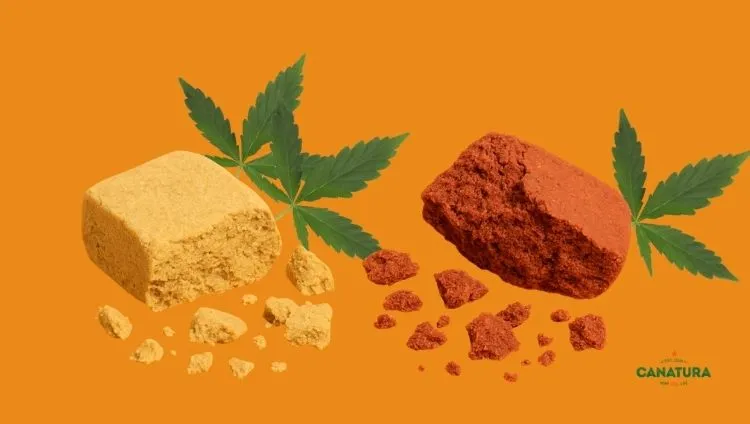
Lebanese hashish (Lebanon hash) tends to be relatively brittle and crumbly compared to the sticky dark varieties from Afghanistan or Pakistan.
Traditionally, there are two variants, which differ in colour and effects:
- Blond Lebanon hash (yellow): comes from an early harvest
- Red Lebanon hash (red): comes from a later harvest
Country of origin and history
Lebanese hashish usually matures in fields under the sun in Lebanon, and is particularly famous in the Bekaa Valley in the east of the country.
Lebanon boasts a long tradition of cannabis cultivation and hashish production. In the 1960s, it was one of the world’s largest exporters, and to this day, this production remains a significant (albeit illegal) part of the local economy.
Method of production
Lebanon hash is produced by dry sifting and subsequent pressing, similar to Moroccan hash. The cannabis plants are left to ripen and dry in the open air in the fields, giving them a brownish to reddish colour.
The dry buds are then rubbed and sifted through fine sieves to separate the resin powder, known as kief. This is then pressed into solid sheets or bricks of hashish and traditionally left to mature slowly for one to two harvest seasons (i.e. several months) in a dry place.
It is this slow maturation that increases the quality of the hashish, giving it a smoother, more pliable consistency, intensifying its spicy and woody aroma and developing a deeper red hue.
Type of cannabis used
Traditional Lebanese cannabis is a native landrace variety originating in the mountains of Lebanon. Some sources classify it as an indica subspecies due to its short stature, rapid maturation and sedative effects, while others point to the presence of sativa phenotypes.
In fact, Lebanese genetics are quite variable: in lower altitudes, more robust indica plants with high resin content are more common, which are suitable for the production of red hashish, while in harsher mountain conditions, narrower, more sativa forms with an uplifting effect prevail.
Red Lebanese hash vs. blond Lebanese hash
- Blond hash is traditionally made from earlier harvested plants with maximum THC content, and the effect is closer to sativa.
- Red hash comes from fully mature plants with a higher CBN content, whose effect is more reminiscent of indica.
In both cases, however, these are original Lebanese landraces, bred for generations for their rich resin content.
Today’s seed banks offer Lebanese landrace lines; for example, Real Seed Company states that some phenotypes are 100% indica, while others have sativa traits.
Overall, however, Lebanese hash is more associated with the indica effect (inducing calm, relaxation and physical well-being).
Effects
Lebanon hash is notable for its balance. It can offer a mind-lifting high along with deep body relaxation. The effect is pronounced and long-lasting and, unlike Afghan strains, is not as sedative.
Users most often describe a pleasant relaxation and a clearer mind without excessive dullness.
- Blond Lebanon: Users report a more “cerebral high” (a type of effect that manifests itself primarily in the head and on a psychological level), i.e. an elevated mood, clearer concentration and creativity (sativa effects).
- Red Lebanon: Users describe stronger physical relaxation and sedation. First comes a feeling of blissful euphoria, which gradually turns into long-lasting calm, heavy eyelids and deep muscle relaxation (Indica effects). Thanks to its CBN content, users choose this hashish for insomnia.
Aroma and taste
Mature Lebanese hashish is characterised by an intense spicy, earthy aroma with undertones of wood and herbs. When broken, it releases a mixture of spices and resin.
- Blond Lebanon: Compared to Red Lebanon, it may have a slightly lighter, more herbal aroma with a hint of citrus. As it matures for a long time, the hashish acquires a distinctive terpene spectrum (its composition includes myrcene, pinene, caryophyllene and others, which give it its characteristic exotic spicy aroma).
- Red Lebanon: It tends to have a richer aroma than Blond Lebanon, usually with notes of rose, incense or earthy cedar. The taste is full-bodied with a sweet, spicy finish.
THC content
Both varieties of Lebanese hashish are prized for their high potency.
- Blond Lebanon hash: It is usually highly psychoactive with a THC content of around 15-20%, and even more in premium products.
- Red Lebanese hash: The psychoactivity may be slightly milder compared to blond Lebanese hash, but it is still intense. This is due to the partial conversion of THC to CBN.
Laboratory-produced hashish (e.g. Lebanese dry sift hashish) can reach around 50% THC, while samples of traditional Lebanese hashish, according to a 2016 scientific study, had a low THC content (around 1–4%) and, conversely, a relatively high CBD content (around 6–13%).
Afghan hash
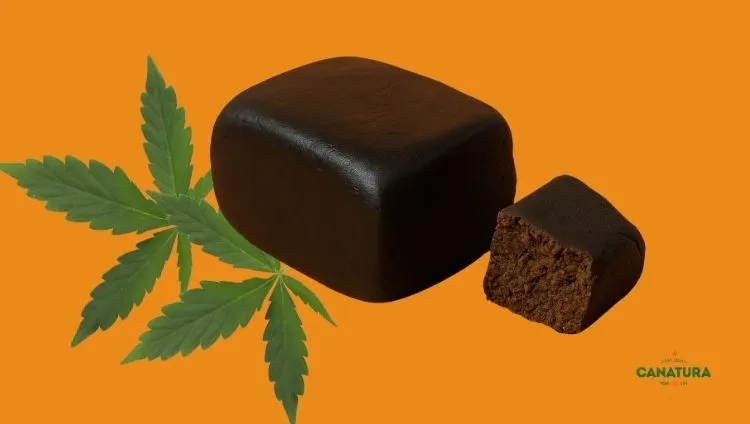
Afghan hash (Afghan hash, Afghan black hash) is soft when fresh and resembles fudge in shape and texture. However, it gradually hardens when exposed to air for a longer period of time. It typically has a black colour on the surface, while the inside is dark brown.
Country of origin and history
Afghan hash originates from Afghanistan, and Afghan black in particular comes mainly from the province of Balkh and the Hindu Kush region (e.g. Mazar-i-Sharif) in the north of the country, where well-known highly resinous cannabis varieties grow.
Afghanistan is currently one of the largest producers of hashish in the world, and Afghan hash is one of the most famous types in the world.
The roots of classic hashish production and use in Afghanistan date back to the Middle Ages, but the real boom came in the 1960s and 1970s. At that time, young travellers on the so-called Hippie Trail discovered the magic of Afghan hashish and demand skyrocketed.
Method of production
Afghan hash is traditionally produced by a combination of dry sifting and manual rubbing while warm. Dried indica buds (known as Afghani) are shaken through a fine cloth, producing kief (locally known as garda). This is then heated and moistened with hot water or tea until it turns into a malleable resinous substance.
The substance is then thoroughly kneaded by hand, sometimes even by traditional barefoot treading, until it acquires a dark brown-black colour and a sticky, plasticine-like consistency. The finished blocks are wrapped in cloth or leather and left to mature briefly.
High-quality Afghan hashish is soft, easily mouldable and resembles plasticine at room temperature. Inside, it has a fresh, lighter brown-green tone, but the surface turns black when exposed to air over time.
Producers usually mark their products with a seal or stamp, with the genuine Afghan Stamp considered a guarantee of origin and quality.
Type of cannabis used
Afghan cannabis consists only of indica landrace varieties (labelled Afghani or Afghan Kush). The Afghan Hindu Kush mountains are considered the likely origin of Cannabis indica, as the local plants are short and bushy and produce large resinous buds.
Centuries of selection have resulted in varieties that are ideal for hashish production, such as Mazar-i-Sharif and Afghan #1, which are renowned for their enormous production of trichomes with a high THC content and late autumn ripening.
These strains are the basic raw material for Afghan Black. Currently, both native landraces and modern hybrids (including crosses with Pakistani and Indian varieties) are cultivated in Afghanistan.
Nevertheless, local hashish retains its typical indica character, i.e. high resin content, dark colour and strong sedative effects. Sativa varieties are not used for hashish production in Afghanistan.
Effects
Afghan hash offers strongly sedative, “grounding” effects. The onset is usually rapid – after just a few puffs, an intense euphoria sets in, which soon turns into a heavy physical high. Typically, the “stone” effect predominates over the “high”.
Users usually describe a “couch-lock” effect, where they remain literally glued to the sofa for hours.
In higher doses, Afghan hash can induce numbness of the senses and a drowsy state reminiscent of opiate intoxication. Therefore, users tend to use it mainly in the evening or when they need deep relaxation, as it brings significant physical relaxation, pain relief, stress relief and sleep support.
At first, some users may also experience a pleasant euphoria and altered perception, which sometimes stimulates the imagination. This is why Afghan black hash was popular among writers and artists in the past.
Overall, however, a long-lasting physical “stone” prevails, which, when used excessively, can develop into a so-called coma high (a state of complete relaxation and mental absence).
Aroma and taste
Afghan hashish is renowned for its very distinctive and pungent aroma. The smell is spicy, reminiscent of a mixture of pepper, incense and earth, which, when heated, develops tones of sandalwood and pine resin.
It leaves a long-lasting taste on the palate with hints of sweetness (reminiscent of molasses or burnt sugar). Thanks to traditional hand processing, Afghan Black can also have a subtle undertone of herbs or tea, which comes from traces of tea leaves or water used in production.
Overall, however, the flavour profile is mainly earthy, spicy and pungent, more pronounced than many other types of hashish. Connoisseurs therefore consider it a “hashish classic” (an intense and somewhat raw taste of the Orient).
THC content
This variety is considered one of the strongest types of hashish. Thanks to the use of resinous indica genetics, it has a high THC content, commonly exceeding 15% and reaching 30-40% in premium samples. It is notoriously potent, and even a small amount can induce a very intense state.
In the 1970s, Afghan Black was one of the most potent hashishes available on Western markets.
It is generally stated that Afghan hashish is stronger than Moroccan hashish (historically weaker), but it does not usually reach the extreme THC levels of modern highly purified extracts (e.g. BHO).
Ketama Morocco hash
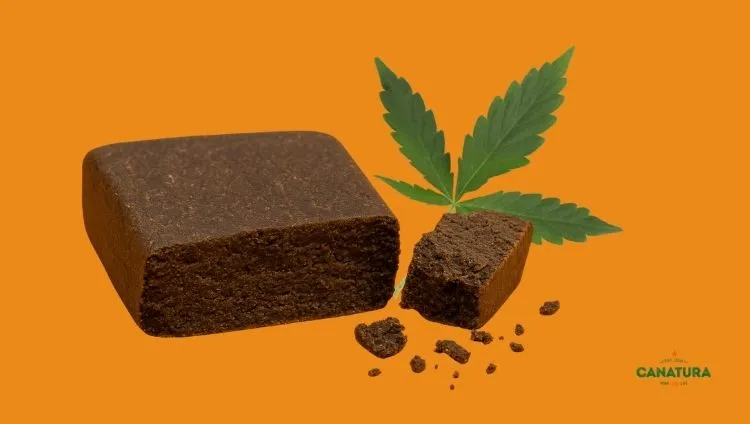
Moroccan hash is usually hard and brittle (nicknamed “pollen” or “soap”), breaks easily and resembles pressed clay or semi-hard chocolate candy in appearance. There are also softer varieties, such as “pollen hash” (less compressed, still pliable hash resembling marzipan).
Country of origin and history
Moroccan hashish (ketama morroco, ketama hash) comes mainly from the Rif Mountains in the north of the country. A famous area is Ketama in the province of Al-Hoceima, which is considered the heart of Moroccan hash culture. Thanks to ideal conditions (mountain slopes, plenty of sunshine and generations of experienced farmers), most Moroccan hashish is produced here, with estimates putting the figure at up to 95%.
Morocco has a long history associated with cannabis. Cultivation is said to have spread here as early as the 7th century thanks to Arab traders, and from the 18th century onwards, smoking dried cannabis (known as kif) in traditional pipes was a common part of the culture.
However, large-scale hashish production did not fully develop until the 20th century with growing demand from Europe.
Today, Morocco is one of the world’s largest exporters of hashish. Moroccan hash, which is also well known in Amsterdam’s coffee shops, is popular for its availability and consistent quality.
The Ketama region also produces famous premium varieties such as “Double Zero (00)” and “Ketama Gold”, which are sought after for their purity and potency.
Production method
Ketama Moroccan hash is produced using a traditional method – dry sieving followed by hot pressing. Dried cannabis branches (locally known as “kif”) are placed on a frame covered with a fine cloth and beaten with a stick or rod. The blows release tiny trichomes from the plants, which fall through the sieve as a fine powder called kief.
The kief accumulates on a smooth surface and the process is repeated as needed. The first sifting produces the purest and lightest material, known as “Double Zero (00)”, while subsequent rounds produce darker and coarser resin.
The kief obtained is then heated (for example, over a hot water bath or direct heat) and pressed into solid blocks using simple presses. In Ketama, so-called Ketaman drums were traditionally used (a stretched fabric over a container on which the dry material was placed and the resin was released by drumming with fists or sticks).
The resulting hashish is shaped into bricks or balls. Moroccan hash is hard, brittle and breaks easily, which is why it is nicknamed “pollen” or “soap”. Its appearance is usually reminiscent of pressed clay or patties similar to chocolate bars.
Type of cannabis used
Traditional Moroccan varieties are known as Beldia and belong to the local sativa landrace types. These plants are well adapted to dry mountain conditions, grow to about 1-2 metres, have narrow leaves, smaller buds and flower quickly.
Botanically, they are sometimes referred to as Cannabis sativa subsp. indica var. kif (so-called Mediterranean indica), but their appearance and effects are more reminiscent of sativas, as they induce an immediate, light “cerebral high”.
The original varieties mentioned above were characterised by a lower THC content and, conversely, a higher CBD content, which gave traditional Moroccan hash a milder and “lighter” effect.
However, since the 1980s, growers in the Rif Mountains have begun to cross local genetics with indica seeds imported from Pakistan and Afghanistan to increase the yield and potency of hashish.
Today’s Moroccan hashish therefore often comes from hybrids (known as Pakistani/Moroccan) that combine the robustness of Indica with the rapid growth of Sativa.
The effect remains predominantly stimulating, although it tends to be heavier than the original Ketama hashish.
It can therefore be said that Moroccan hashish once had a distinctly sativa character, whereas modern forms are more of a mix of indica and sativa , yet they retain a lighter, more “sativa” character than Afghan varieties.
Effects
It is generally said that the effect of Moroccan hashish is milder and uplifting. Unlike the sedative Afghan effect, Moroccan hashish offers a more euphoric “high”, i.e. improved mood, light-headedness and a flood of creative thoughts.
Users most often describe a pleasant, balanced state that combines stimulation with relaxation. Due to its lower THC content, it does not usually cause paranoia or severe drowsiness, but mainly induces a clear and lucid high with a touch of well-being and laughter.
Traditionally in Morocco, hashish was mixed with tobacco in so-called kif cigarettes, which were part of social life and encouraged conversation and good humour. High-quality varieties (e.g. “00”) can also offer a relatively strong effect, but still more stimulating than sedative (typically not inducing “couch-lock”).
Overall, Moroccan hash is used during the day and on social occasions. It offers a lighter, more energetic experience than heavy Asian hashes. In higher doses, drowsiness may occur, but the effect usually wears off gradually and turns into pleasant tiredness.
Aroma and taste
Moroccan hashish has a more delicate and sweeter aroma than its Eastern counterparts. The scent is earthy and herbal with notes of spices that are not too sharp or pungent. There are often hints of herbs, flowers and slightly sweet spices, sometimes with undertones of fruit or honey.
Users compare the taste to sandalwood and mint with a subtle hint of black pepper, i.e. spicy and sweet, but not too heavy.
High-quality Moroccan hash (e.g. premium “00”) is valued for its aroma, smoothness and balanced flavour complexity. On the other hand, lower-quality varieties (“soap”) can taste sharper and leave a bitter aftertaste.
THC content
Traditional Moroccan hashish used to be milder in the past. Common export samples had a THC content of around 8-12%, which is less than Afghan hashish.
The reason for this was the original Moroccan Beldia varieties, which were bred mainly for yield and adaptation to conditions, not for high potency – pure Beldia landrace reportedly contained only about 3% cannabinoids in its flowers. The resulting hash was therefore not extremely potent, but mostly stood out for its purity and quality of processing.
In recent decades, the situation has changed. Moroccan growers have begun to cross local genetics with modern hybrids, often with genes from Pakistan or Europe, thereby increasing the THC content. New types of Moroccan hashish can now reach 20–30%, and in rare cases even more.
In general, Moroccan hash is weaker than the heavy black hash from Asia.
Pakistani hash
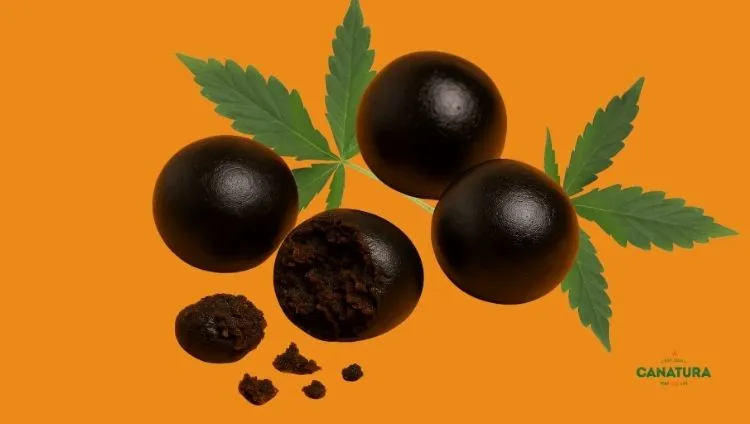
Traditionally, hashish in Pakistan is left to mature and sometimes shaped by hand into balls or rolls. The surface is shiny and sticky, and the colour is very dark.
Country of origin and history
Pakistan hash comes from Pakistan, mainly from the northern mountainous region near the border with Afghanistan (Khyber Pakhtunkhwa province and tribal areas).
As in neighbouring Afghanistan, hashish production has deep roots in the local culture. Cannabis cultivation and resin processing have been part of the tradition for centuries, although cannabis is officially illegal in this country.
The area is home to legendary strains such as Hindu Kush and Chitrali. The Swat Valley is particularly famous for its production of high-quality “Pakistan black” hash.
Pakistani hashish was originally used mainly for domestic consumption and surrounding regional markets, but thanks to smuggling routes, it also found its way to Europe, where it was often sold in coffee shops simply as “Pakistani”.
Method of production
The production process for Pakistani hash is very similar to that of Afghan hash, and it is sometimes even referred to as “Afghan hash produced across the border”.
Ripe cannabis plants are first dried and then sieved to obtain a fine powdery kief. This is then heated and pressed into a thick mass, which is manually formed into blocks or balls. As in Afghanistan, a few drops of water or tea are sometimes added during processing to help the resin bind together better.
However, a unique Pakistani speciality is the subsequent maturation of hashish in animal skin. The best hash is wrapped in goat or sheep skins and left to mature for 3-12 months in a cool place. This allows the resin to “breathe” and acquire a more distinctive taste, aroma and potency during maturation.
Finished Pakistani hash usually takes the form of black, shiny blocks or balls (known as “charas balls” – even though they are not technically produced using the charas method).
The consistency is usually soft and malleable, often stickier than Afghan hash, as it contains more natural oils.
The highest quality is considered to be “Awal Namber Garda” (literally “first-class dust”), i.e. hash made from the very first, purest sifted kief. Weaker variants come from the second or third sieve.
Type of cannabis used
As in Afghanistan, it is mainly indica landrace varieties from the Hindu Kush mountains. Northern Pakistan shares its cannabis heritage with neighbouring Afghanistan, and varieties such as Mazari Sharif, Kandahar and Charas (not related to the charas method) are widespread.
Pakistani plants tend to be robust, with dark leaves and a large amount of resin, making them ideal for hashish production.
Traditional growing areas include the Swat Valley, Chitral District and the regions around Peshawar. Local farmers have been breeding cannabis for generations specifically for hashish production, resulting in very resinous Indicas, mostly referred to collectively as Pakistani. One of the best known is Pakistan Chitrali, a variety with purple flowers and a distinctly aromatic resin, which made its way to Morocco and Europe in the 1980s to improve the performance of plants there.
Unlike Morocco, traditional sativas are not found in Pakistan. Everything is subordinated to the production of hashish, i.e. indica genetics and their hybrids.
The local term “Chars” (charas) is used for hashish in general, although true charas (hand-rubbed resin from fresh plants) is the domain of India. Genetically, Pakistani hash belongs to the Afghan Indica family, which is reflected in its strong sedative effects.
Effects
Pakistani hashish has earned a reputation as a real “couch-lock”. Users describe the effects as extremely strong, heavy and long-lasting. First comes a wave of euphoria, which quickly turns into deep physical sedation. Within a few minutes, there is a marked relaxation of the muscles, slowing of thoughts and general numbness, accompanied by strong relaxation.
Higher doses induce a state in which a person sits or lies calmly for several hours, literally “petrified”, which is typical for indica genetics. In smaller doses, it can briefly bring euphoria and laughter, but the effect soon turns into sedation.
The high is even described as long-lasting, as the strong effect lasts for 3-4 hours and then slowly fades away. Users choose Pakistani hash mainly in the evening.
This type of hashish is a symbol of “couch lock” in its purest form.
Aroma and taste
The aroma of Pakistani hash is very similar to Afghan hash, but it is more spicy and pronounced. The smell is rich and spicy with notes of cardamom, pepper, cloves and earth. When crumbled, it releases a pungent aroma reminiscent of a mixture of oriental spices with a sweet woody undertone.
The taste is dominated by earthy-spicy notes, especially pepper and hashish tar, sometimes with a slightly bitter aftertaste. High-quality Pakistani hash may also have subtle hints of herbs or conifers, but overall it tends to be heavier and less refined than Moroccan hash.
It leaves a long-lasting oily sensation on the palate. Traditional hashish may contain small plant fibres that crackle when burned.
Overall, the taste and aroma of Pakistani hash is distinctly spicy and heavy, indicating a high concentration of resin and terpenes.
THC content
Pakistan hash ranks alongside Afghan hash in terms of potency and is among the strongest in the world. Typical THC values range from 15-25%, with top samples exceeding 30%.
Local indica varieties, such as the famous Mazari or Shinwari, produce extremely resinous flowers, making the resulting hash exceptionally potent.
In general, even a small amount of this hash can have a significant effect. Traditional Pakistani “hash bricks” have a high THC content and long-lasting effects.
Of course, there are also weaker and lower-quality variants, which are usually darker, dry and less sticky, sometimes even diluted with oil or other additives. However, it is said that the first-class Pakistani “Awal Namber” is fully comparable in quality and potency to the best Afghan hashes.
Conclusion
Hashish has a thousand-year history that is closely linked to the culture, traditions and countries of Lebanon, Afghanistan, Morocco and Pakistan.
Each region offers a unique product, from uplifting Moroccan “soap” to balanced Lebanese hash to heavy Afghan and Pakistani “couch-lock”.
FAQ
Check out other questions that interest you most in relation to this topic.
1. What is kief?
Kief is a fine resin powder that is released from cannabis flowers when rubbed or sifted through fine sieves. It contains concentrated trichomes, the part of the plant with the highest concentration of cannabinoids and terpenes.
Kief is traditionally used to press hashish – the quality of the final product often depends on the purity and fineness of this powder.
2. What is skuff?
Skuff (skaf) is a fine resinous powder made from trichomes – essentially unpressed kief. It is used to make hashish, but users can also vape it on its own or add it to joints.
Compared to classic pressed hash, it is lighter, looser and often more aromatic.
3. What is charas hashish?
Charas is a traditional hashish from India and Nepal, produced by hand-rubbing live, fresh cannabis plants.
During this process, the resin sticks to the palms and is then scraped off into soft, dark balls. The effect is usually strong and often perceived as spiritual.
To this day, charas is part of religious rituals, for example among the sadhus in the Himalayas.
4. What is the charas method?
The charas method is a process in which resin is obtained directly from fresh plants by rubbing them between the palms of the hands.
Unlike the Moroccan or Afghan method (sifting dried plants), it involves the production of “live” cannabis. The result is a black, soft and aromatic hashish that differs in taste and effects.
5. Is hashish legal?
No. In the Czech Republic and most of Europe, classic hashish containing THC is not legal. Only products containing up to 0.3% THC (up to 1% in the Czech Republic) are permitted.
6. What are the legal alternatives?
Legal alternatives to traditional hashish include various types of cannabis extracts, primarily CBD hashish, but also products containing other cannabinoids such as CBDP, H4CBD, THCV, CBG9, CBNO, 10-OH-HHC, 8-OH-HHC, 10-OH-HHCP and THCX.
The legislation on specific cannabinoids varies from country to country.
7. What CBD hashish can I buy at Canatura?
At Canatura, you will find:
- Canntropy CBD Hash Morocco
- Canntropy CBD Hash Lebanon
- Euphoria CBD Hash Afghan 25% CBD, 1 g
- Euphoria CBD Hash Moroccan 25% CBD, 1 g
- Euphoria CBD Hash Gelato 19% CBD, 1 g
- Euphoria CBD Hash Candy Jack ,19% CBD, 1 g
- Eighty8 Bubble Hash 25% CBD, 1 g
- Eighty8 Dry Sift Hash 12% CBD, 1 g
- Eighty8 CBD Concentrates – All in One Set – 6 types
Each has a slightly different flavour profile and intensity, but they all share a high CBD content.
Sources:
- sciencedirect.com/science/article/abs/pii/S0955395914000036
- lumirlab.com/publication/the-main-cannabinoids-content-in-hashish-samples-seized-in-israel-and-czech-republic
Author: Patricie Mikolášová
Photo: AI
“All information provided on this website, as well as information provided through this website, is for educational purposes only. None of the information contained herein is intended to be a substitute for a medical diagnosis and should not be considered medical advice or recommended treatment. This website does not endorse, condones or advocate the licit or illicit use of narcotic drugs or psychotropic substances or the commission of any other illegal activity. For more information, please see our Disclaimer .”

