Does teeth grinding while sleeping bother you? Find out what research says about CBD and bruxism
- Teeth grinding: what is bruxism?
- What research says about CBD and bruxism
- Overview of clinical studies on CBD and bruxism
- How might CBD work for teeth grinding?
- Bruxism and treatment: what is the standard approach, and where is the evidence still unclear?
- Tips for stopping teeth grinding
- CBD for bruxism: what studies show and where the limits lie
- FAQ
Teeth grinding: what is bruxism?
Bruxism refers to the activity of the chewing muscles that results in, for example, teeth grinding or clenching.
Experts distinguish two main forms (circadian phenotypes) based on when it occurs:
- sleep-related (grinding during sleep, sleep bruxism)
- awake (clenching or grinding during the day, awake bruxism)
In healthy people, bruxism is not always considered a “disorder.” It is generally more of a specific type of behavior that can have various effects.
In some people, it may have almost no noticeable effects, while in others it can contribute, for example, to jaw muscle pain, tooth wear, or complications with dental prosthetics.
Manifestations of bruxism
Bruxism can manifest in various ways, which often overlap.
The most common are:
- grinding or clenching of the teeth during sleep
- clenching the teeth
- clenching the jaws during the day
However, it can also manifest as repeated clicking of the teeth or excessive jaw movements with tooth contact.
In everyday language, we most often refer to teeth grinding during sleep—that is, a situation where you unconsciously grind your teeth or clench your jaw tightly during the night.
This condition can manifest, for example, as:
- pain in the chewing muscles
- morning jaw fatigue
- headaches
- clicking in the jaw joint
- increased tooth wear or sensitivity
In recent years, interest in CBD (cannabidiol) has been growing in connection with bruxism, as this cannabinoid interacts with the body’s endocannabinoid system (ECS).
The ECS plays a role in regulating pain, inflammation, stress, and sleep—all of which are closely linked to bruxism.
That is precisely why scientists have begun to investigate in recent years whether CBD might offer some benefit in this regard.
What does research say about CBD and bruxism?
What does the research say so far about CBD and bruxism? Below you will find specific studies and their results.
First evidence of relaxation of the masticatory muscles
A study published in 2019 in the Journal of Clinical Medicine examined the effects of topical application of CBD gel to the skin in the area of the masticatory muscles.
The study included 60 patients with myofascial pain and temporomandibular joint disorders (TMD).
The results showed that in the group using CBD, there was a significant reduction in muscle activity measured by sEMG within 14 days, along with a marked decrease in pain compared to the placebo group.
For bruxism research, this study is important primarily as evidence of the potential muscle-relaxing and analgesic effects of CBD on the masticatory muscles.
However, bruxism itself was not the primary outcome measure in this study.
The study focused primarily on pain and muscle activity in patients with TMD, with bruxism mentioned in this context more as a related factor.
At the same time, this work represents a technological precursor to later studies that have already investigated the application of CBD directly in the mouth, in the area of the masticatory muscles.
Teeth grinding during sleep: a study tested CBD gel
A more recent clinical study published in 2025 in the journal Pharmaceuticals investigated the potential effects of CBD in people with bruxism.
The randomized, double-blind study included 60 participants, who were divided into 3 groups. Group 1 used a placebo gel (without the active ingredient), Group 2 used a gel with 5% CBD, and Group 3 used a gel with 10% CBD.
The gel was applied directly to the mouth on the masseter muscle (the main muscle involved in chewing) once daily before bedtime for 30 days.
Researchers objectively monitored bruxism using muscle activity measurements (sEMG) and the Bruxoff® device, which records episodes of teeth grinding.
However, the primary outcomes monitored in this publication were sleep quality (assessed using the PSQI questionnaire) and migraine burden (assessed using the MIDAS questionnaire).
The results showed that, compared to the placebo group, both groups using CBD experienced a statistically significant improvement in sleep quality and a reduction in migraine burden.
No significant difference in effect was observed between CBD concentrations of 5% and 10%.
In terms of safety, the study reports that participants did not report any serious adverse effects or oral mucosal irritation during the 30-day period of use.
According to the authors, one application (the dose used) corresponded to approximately 25–50 mg of CBD (depending on the gel concentration and the fixed amount).
At the same time, however, they note that this was only a short-term study lasting 30 days, so it is not yet clear how CBD would work with long-term use.
Teeth grinding at night: CBD reduced symptoms by half
One of the strongest pieces of direct evidence regarding CBD’s effect on reducing bruxism activity came from a study published in 2024 in the Journal of Clinical Medicine.
This was again a three-arm, randomized, double-blind clinical trial involving 60 patients with sleep bruxism and temporomandibular disorders (TMD).
The researchers monitored changes in pain (assessed using the VAS scale), muscle activity (sEMG), and the bruxism index measured by the Bruxoff® device. Assessments were conducted at three time points—at the start of the study (day 0), after 14 days, and after 30 days.
The results showed that the 10% CBD gel significantly reduced both subjective pain and muscle activity. At the same time, this group recorded the greatest decrease in the sleep bruxism index, by approximately 51%.
CBD dosing in the study was precisely standardized using a dispenser.
One dose corresponded to 0.2 g of gel on each side of the jaw. In the 10% CBD group, this amounted to 20 mg of CBD on each side, for a total of 40 mg of CBD per day.
For the 5% CBD gel, the authors report a total dose of approximately 20 mg of CBD per day.
The description of the dosing in the publication is less intuitive given the stated concentration; therefore, the interpretation is taken directly from the published study protocol.
In terms of safety, the study reports that during the observation period, patients did not report any adverse effects associated with the products used.

Teeth grinding during the day: in one patient, CBD nearly eliminated bruxism
A study published in 2021 in the journal Neurocase describes a specific case of a patient (a so-called case report) with a rarer type of dementia (frontotemporal), who exhibited significant waking bruxism.
After starting a capsule containing 4.8 mg of CBD and 0.31 mg of THC, administered in the morning, the bruxism almost completely disappeared. This effect persisted for 6 months.
However, it is important to emphasize that this is only a single clinical case involving a patient with a neurological disorder who had previously undergone various treatments, including botulinum toxin injections.
Therefore, the results cannot be directly generalized to the general population of people with sleep bruxism. Rather, this case may suggest possible directions for further research.
Overview of clinical studies on CBD and bruxism
For a better overview, the following table summarizes the main clinical studies that have examined the effect of CBD on bruxism or related conditions.
| Study | Who the study followed | Form and dose of CBD | Key findings | Quality of evidence |
|---|---|---|---|---|
| J Clin Med, 2019 | 60 adults with masticatory muscle pain and TMD; bruxism as a related factor | CBD gel applied to the skin over the masticatory muscles, twice daily, for 14 days | Reduced muscle activity and significant reduction in pain vs. placebo | Low to moderate – short study and small number of participants; mainly monitored pain and muscle activity, not bruxism directly |
| J Clin Med, 2024 | 60 adults with sleep bruxism and muscle-related TMD | Gel applied in the mouth; 10% CBD: 20 mg per side (40 mg/day); 5% CBD: approximately 20 mg/day | Reduction in pain, muscle activity, and a decrease in the sleep bruxism index (~51% with 10% CBD) | Moderate – the study was blinded and used objective measurements, but had a relatively small sample size and short follow-up |
| Pharmaceuticals, 2025 | 60 adults with bruxism and masticatory muscle pain | Gel applied in the mouth; approximately 25–50 mg of CBD daily | Improved sleep quality and reduced migraine burden vs. placebo | Moderate for sleep and migraine, but only indirect evidence for bruxism, as the primary outcomes were different |
| Neurocase, 2021 | 1 patient with a neurological disorder and severe awake bruxism | Capsules: 4.8 mg CBD + 0.31 mg THC in the morning | Almost complete resolution of bruxism, effect lasting 6 months |
Very low – this is only a single clinical case in a patient with another |
In summary, current studies suggest that CBD may help reduce pain in the masticatory muscles, muscle activity, and sometimes even the intensity of bruxism itself.
However, most studies are still short-term and involve a small number of participants.
How might CBD work for teeth grinding?
Current findings show that bruxism is not just a problem with the bite or the teeth themselves. It is more about the activity of the masticatory muscles, which is centrally controlled by the nervous system.
Therefore, attention is also turning to factors such as pain, muscle tension, stress, and sleep quality, which are often associated with bruxism.
However, these effects cannot yet be considered a definitively proven mechanism specifically in people with bruxism—clinical studies so far have mainly monitored outcomes such as pain, muscle activity, the bruxism index, or sleep quality, rather than the actual biochemical processes in the body.
The authors of more recent studies explain the effect of CBD primarily by its potential to act locally on pain and muscle tension.
This is consistent with their findings: in some studies, the use of CBD gel led to a reduction in pain and muscle activity, and in some research, a decrease in indicators associated with bruxism.
Another study suggested improved sleep quality and relief from migraines.
The scientific literature indicates that CBD may influence pathways associated with pain perception (e.g., TRPV1), and preclinical studies have shown its potential effect on increased pain sensitivity and tissue sensitivity.
However, this is currently mainly a supporting explanation based on laboratory and animal models; it is not direct evidence of the mechanism in people with bruxism.
In simple terms, the potential effect of CBD could look like this:
Less pain and reduced sensitivity of the masticatory muscles → lower muscle tension and activity → better sleep and a reduced impact of related issues.
However, this currently represents more of a “working hypothesis” consistent with existing study results than a definitively confirmed mechanism.
Bruxism and treatment: what is the standard approach, and where is the evidence still unclear?
In clinical practice, treatment for bruxism usually focuses primarily on protecting the teeth and alleviating symptoms, rather than necessarily on completely stopping the muscle activity itself.
Professional reviews list several main approaches, including:
- protective splints
- behavioral methods
- biofeedback
- certain medications
However, study results are quite varied, and for many methods, strong evidence of their effectiveness is still lacking.
Protective splints (teeth grinding guards)
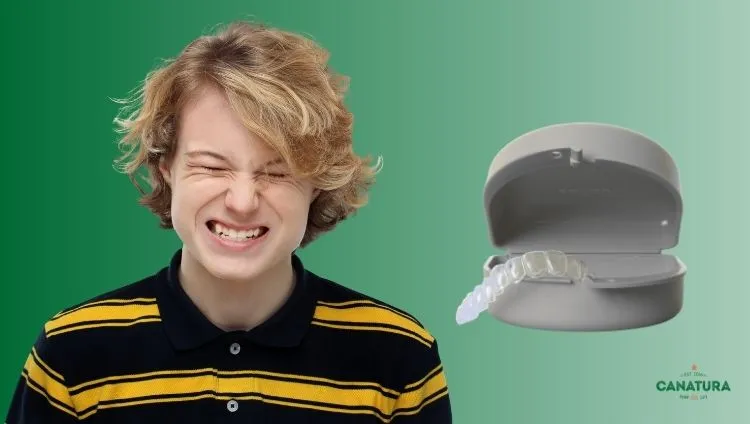
The most common method is a night guard (teeth grinding guard). Its main purpose is to protect the teeth from wear and reduce the strain on the jaw muscles.
These splints are commonly used for both bruxism and temporomandibular disorders (TMD).
Some studies suggest that they may help alleviate symptoms in the long term, but there is currently no clear evidence that they are significantly more effective than other approaches, such as physical therapy.
Biofeedback
Another option is biofeedback, a method that helps a person become more aware of muscle tension and gradually regulate it.
Some studies show that biofeedback can reduce bruxism parameters while also improving pain compared to a standard protective splint.
These results suggest that behavioral and neuromodulatory approaches (approaches focused on the nervous system) can influence the activity of the masticatory muscles themselves, not just protect the teeth.
This principle is also interesting in the context of CBD research, although its potential effects would likely occur through a different mechanism.
Medications
In some cases, doctors may prescribe medications that affect muscle activity or sleep, such as benzodiazepines, for short-term use.
However, these medications have their limitations, as they can cause drowsiness, tolerance, or dependence, and are therefore generally not used long-term.
With CBD, the picture is somewhat different. Studies focusing on bruxism have not reported sedation or other systemic side effects.
It is important to note, however, that these involved topical application (e.g., gel applied to the masticatory muscles) and were short-term studies.
With systemic CBD (such as oral use), drowsiness, potential liver strain, and interactions with certain medications have been reported in other medical indications.
Therefore, it is always necessary to consult a doctor before using CBD.
Botulinum toxin
In more severe cases, botulinum toxin (BoNT-A) is also injected into the chewing muscles.
This method is mainly used when standard conservative treatments are ineffective and the patient experiences severe pain or enlarged chewing muscles.
According to some reviews, botulinum toxin may help reduce both pain and muscle activity, but the quality of available studies varies considerably.
Nevertheless, it is an important treatment option because it acts directly on the muscles involved in bruxism.
Tips for stopping teeth grinding
The following recommendations are based on current scientific evidence and clinical practice.
These are not individual health recommendations. CBD is considered a complementary or experimental approach.
Determine what type of bruxism you have
Before you start figuring out how to stop grinding your teeth or how to break the habit of teeth grinding, you need to clarify a few things:
- whether it is sleep bruxism or awake bruxism
- whether bruxism is causing problems, such as jaw pain, tooth damage, or sleep disorders
- whether it is more of a behavior without significant health consequences—experts noted in 2018 that bruxism may not always be a disorder, but sometimes just a behavior with little impact on health.
First step for adults: protecting teeth and alleviating symptoms
If bruxism causes pain or tooth damage, the dentist will usually recommend a mouthguard (night guard).
Treatment may also include:
- physical therapy for the jaw muscles
- education and behavior modification
- other conservative treatments as needed
Although the scientific evidence for some methods is not always strong, protective splints are frequently used in practice because they effectively protect teeth from mechanical damage.
When jaw clenching is related to stress
In awake bruxism, psychological and behavioral factors are also often important, such as stress or unconscious jaw clenching during the day.
The following may help:
- relaxation techniques
- jaw relaxation exercises
- biofeedback, which helps you become more aware of muscle tension
These approaches can help influence the activity of the chewing muscles themselves, not just protect the teeth.
CBD for teeth grinding: what you should know
Research suggests that CBD may be particularly beneficial for people with sleep bruxism and concurrent jaw muscle pain or temporomandibular joint (TMJ) disorders.
In some clinical studies, topical application of CBD gel to the masticatory muscles led to reduced muscle activity and pain. One study also suggested improved sleep quality and relief from migraines.
In practice, however, the potential use of CBD should be considered a short-term trial approach and should not replace standard procedures, such as a protective mouthguard.
However, CBD is not suitable for everyone. Caution is advised, especially in the following situations:
- when taking medications
- in cases of liver disease
- during pregnancy or breastfeeding
With oral CBD, side effects such as drowsiness, potential liver strain, and interactions with certain medications have been reported in other indications.
When purchasing CBD products, it is important to consider:
- product quality (quality can vary on the market; request lab analyses)
- the THC content in the products (full-spectrum products contain trace amounts of THC up to 0.3%)
It should be noted that clinical studies on bruxism used gel (topical application), not commonly sold CBD oils.
CBD for bruxism: what studies show and where the limits lie
A summary of existing research suggests that CBD may offer some benefit to certain people with bruxism, particularly adults with sleep bruxism and concurrent masticatory muscle pain or temporomandibular joint (TMJ) disorders.
Clinical studies from recent years show that applying a CBD gel (5–10%) topically to the masticatory muscles for approximately 2–4 weeks can reduce muscle activity and pain.
Furthermore, one of the more recent studies suggested that CBD could also help improve sleep quality and reduce the burden of migraines.
These issues may be related to bruxism and sometimes create a “vicious cycle” in which pain and poor sleep promote further muscle activity.
CBD is not a standard part of bruxism treatment and does not appear in official dental or pediatric guidelines.
Existing studies also have several limitations—they often involve a small number of participants, short follow-up periods, and are conducted at a single research center.
There is also a lack of direct comparisons with standard treatment methods, such as protective mouthguards, biofeedback, or botulinum toxin.
It is also important to note that CBD may have different legal statuses in various countries.
While it is not considered a narcotic in the EU, a distinction must be made between approved medications and over-the-counter products.
FAQ
Check out other questions that interest you most regarding this topic.
1. What causes teeth grinding at night?
Teeth grinding at night (sleep bruxism) is usually associated with the activity of the chewing muscles controlled by the nervous system. It is therefore not just a problem with the teeth or bite.
Factors that may be related to nighttime teeth grinding include, for example:
- stress
- anxiety
- sleep disorders
- certain neurological mechanisms
- increased muscle tension in the jaw area
In some cases, bruxism may also be related to temporomandibular joint (TMJ) pain, the use of certain medications, or the consumption of alcohol and caffeine before bedtime.
However, the exact cause is often unclear, and for each person, it may involve a combination of multiple factors.
2. Is teeth grinding normal in children?
Teeth grinding can also occur in children, and in many cases, it is not a cause for concern.
In younger children, bruxism often occurs during tooth eruption or when the dentition is changing.
Current research indicates that the number of high-quality studies on the treatment of bruxism in children is relatively limited.
When deciding on treatment for children, therefore, the child’s age, stage of growth, and whether the procedure is reversible (i.e., easily reversible) are often taken into account. For example, the use of protective splints can sometimes be more difficult in children during growth.
Professional recommendations therefore typically suggest gentle and reversible approaches as the first step, such as:
- educating the child and parents
- physical therapy or jaw muscle exercises
- behavioral approaches
- possibly certain medications as recommended by a doctor
- in some cases, even mouthguards to prevent teeth grinding
Conversely, irreversible interventions, such as bite adjustments or orthodontic procedures performed solely for the purpose of treating bruxism, are generally not recommended as a first-line treatment for children due to limited evidence.
Moreover, in most children, teeth grinding resolves on its own over time.
However, if it is frequent, causes pain, or leads to significant tooth wear, it is advisable to consult a dentist or pediatric specialist.
3. How can you stop grinding your teeth?
Completely “breaking” the habit of bruxism is not always easy, as much of the teeth grinding occurs unconsciously, especially during sleep.
The goal of treatment is therefore usually to reduce symptoms and protect the teeth.
Among the most common recommendations are, for example:
- a night guard (mouthguard)
- stress reduction and relaxation techniques
- limiting caffeine and alcohol before bedtime
- physical therapy or jaw muscle exercises
- or behavioral methods or biofeedback
In some cases, a doctor may also recommend other treatment options.
4. Does teeth grinding have a psychosomatic cause?
Yes, in some people, teeth grinding (bruxism) may be related to stress, anxiety, or long-term psychological tension.
Scientific studies show that bruxism is generally a multifactorial condition involving both biological and psychological factors, such as stress, sleep disorders, or lifestyle.
Psychological stress can thus increase tension in the chewing muscles or lead to unconscious clenching of the jaws, especially during the day.
However, this does not mean that bruxism is always purely psychosomatic—it is usually a combination of multiple factors.
5. What exercises can help with bruxism?
Exercises for bruxism are simple. They focus on relaxing the chewing muscles, improving jaw mobility, and reducing muscle tension.
Basic types of exercises include:
- gently opening and closing the mouth while controlling the movement
- stretching the chewing muscles (e.g., with light finger pressure)
- jaw coordination exercises (smooth movements without clenching)
- postural exercises (head and neck posture)
Research shows that these exercises can help reduce pain, improve jaw function, and limit excessive muscle activity.
The evidence is not yet entirely consistent, and the exercises work primarily as part of a comprehensive approach.
6. Does Botox help with bruxism?
Botulinum toxin (Botox) is sometimes used as a treatment option for bruxism, particularly in cases where severe jaw muscle clenching or pain is predominant.
It is injected directly into the chewing muscles (most commonly the masseter muscle) and temporarily weakens them. This can reduce muscle activity and the pressure caused by teeth grinding, as well as alleviate pain.
The effect usually lasts several months and does not address the causes, but rather suppresses the symptoms.
7. How can bruxism be treated?
Bruxism usually cannot be “cured” by a single specific method.
Treatment focuses more on managing symptoms and eliminating triggers, and usually combines several of the approaches mentioned above.
Sources:
- mdpi.com
- mdpi.com/1424-8247/18/7/1064
- mdpi.com/2077-0383/13/5/1417
- mdpi.com/2077-0383/8/11/188
- mdpi.com/2077-0383/14/19/6803
- pure.au.dk/ws/files/168150917/Lobbezoo_et_al_2018_Journal_of_Oral_Rehabilitation.pdf
- sciencedirect.com
- sciencedirect.com/science/article/pii/S1013905222001754
- sciencedirect.com/science/article/abs/pii/S1532338218300897
- sciencedirect.com/science/article/abs/pii/S0022391322003316
- sciencedirect.com/science/article/abs/pii/S0929693X21002396
- sciencedirect.com/science/article/pii/S1882761622000059
- nature.com/articles/s41386-020-0667-2
- link.springer.com/article/10.1007/s00784-020-03270-z
- tandfonline.com/doi/full/10.1080/13554794.2021.1917620
- frontiersin.org
- frontiersin.org/journals/oral-health/articles/10.3389/froh.2023.1166091/full
- frontiersin.org/journals/oral-health/articles/10.3389/froh.2023.1170966/full
- franklinsusanibar.com/wp-content/uploads/2019/09/2013-lobbezoo-Bruxism-defined-and-graded-an-international-consensus-2012.pdf
- aapd.org/media/Policies_Guidelines/BP_TempDisorders.pdf
- ema.europa.eu/cs/documents/product-information/epidyolex-epar-product-information_cs.pdf
- euda.europa.eu/news/2020/cannabidiol-cbd-is-not-considered-a-narcotic-drug-under-european-law
Author: Patricie Mikolášová
Photo: Canva
“All information provided on this website, as well as information provided through this website, is for educational purposes only. None of the information contained herein is intended to be a substitute for a medical diagnosis and should not be considered medical advice or recommended treatment. This website does not endorse, condones or advocate the licit or illicit use of narcotic drugs or psychotropic substances or the commission of any other illegal activity. For more information, please see our Disclaimer.”