Delta-8-THC: effects, risks, and legal status in Europe
- What is delta-8-THC?
- Chemical structure
- Effects of delta-8-THC
- Side effects and risk
- Legal status of delta-8-THC in Europe
- Manufacture and distribution of products
- Product quality and safety
- Delta-8-THC: between scientific interest and legislation
- FAQ
What is delta-8-THC?
Delta-8-tetrahydrocannabinol (delta-8-THC) is an isomer of the main psychoactive component of cannabis, tetrahydrocannabinol (delta-9-THC, THC). In the Cannabis sativa plant, delta-8-THC occurs only in trace amounts, while delta-9-THC is one of the main and most widespread cannabinoids.
The cannabinoid delta-8-THC is also referred to as Δ8-THC, Δ8-tetrahydrocannabinol or (−)-trans-Δ8-THC. Standard delta-8-THC has a pentyl (C5) chain, which is why it is sometimes referred to as Δ8-THC-C5.
In practice, delta-8-THC is obtained (semi)synthetically for commercial purposes, most often by isomerising CBD (cannabidiol) extracted from industrial hemp using acid and heat. If the process is not sufficiently controlled, small amounts of delta-9-THC and other side isomers may be produced in addition to delta-8-THC.
Chemical structure
The double bond in the delta-8-THC molecule is located between the 8th and 9th carbon atoms in the chain, whereas in delta-9-THC, the double bond is between the 9th and 10th carbon atoms. This seemingly small change in structure has a significant effect on the properties of the substance.
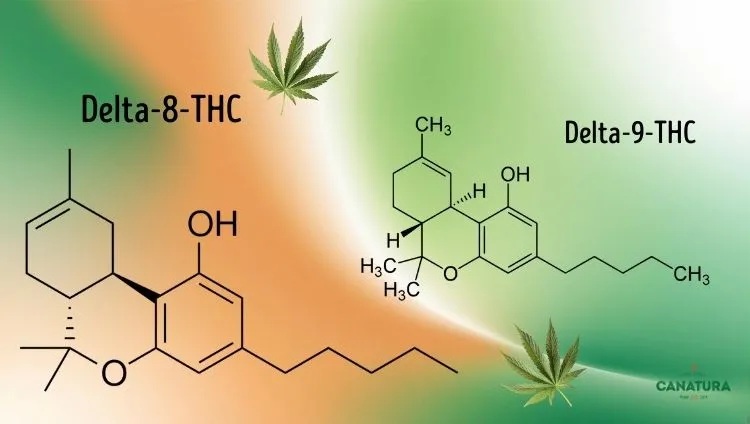
The molecular formula of delta-8-THC is C21H30O2 (the same as delta-9-THC, differing only in the arrangement of the double bond in the molecule).
The chemical differences are also reflected in the stability and effects of these isomers.
Research indicates that delta-8-THC has a lower affinity for the CB1 receptor (the main receptor in the brain) in the endocannabinoid system than delta-9-THC. This manifests itself in lower psychotropic potential.
Older studies reported that the psychoactivity of delta-8-THC is approximately two-thirds that of delta-9-THC, while other estimates put it at only about one-third.
On the other hand, a recent assessment by the European Food Safety Authority (EFSA) states that, in terms of biological effects, both isomers can be considered roughly equipotent, i.e. comparably effective.
Delta-8-THC is chemically more stable than delta-9-THC, which was one of the reasons why it was considered for possible therapeutic use.
Effects of delta-8-THC
The pharmacological profile of delta-8-THC is very similar to that of delta-9-THC, as both bind to the cannabinoid receptors CB1 (primarily in the central nervous system) and CB2 (primarily in the immune system).
When delta-8-THC is used, a similar spectrum of effects to THC occurs:
- euphoria
- relaxation
- altered perception of time
- impaired short-term memory and concentration
- increased appetite
Subjectively, however, the psychoactive effect is weaker – users often describe a milder “high” than with delta-9-THC. For example, in a survey of 521 delta-8-THC users, the majority reported significant relaxation and euphoria, as well as less anxiety and paranoia than when using delta-9-THC.
Therefore, delta-8-THC is sometimes nicknamed the “milder brother of THC” and is informally referred to as diet weed or weed lite due to its allegedly lower intensity of effects. However, these differences have not yet been confirmed by extensive clinical studies.
From a scientific point of view, delta-8-THC is also of interest for its potential therapeutic uses. As early as the 1970s, research on a small sample of individuals suggested that delta-8-THC exhibits approximately two-thirds of the psychoactivity of delta-9-THC and has qualitatively very similar effects.
A remarkable study from 1995 administered delta-8-THC to paediatric oncology patients as an antiemetic (against nausea) during chemotherapy. No vomiting was observed in 8 patients over an 8-month period, leading the authors to conclude that delta-8-THC effectively suppresses nausea and, due to its higher chemical stability, may be more suitable for this purpose than delta-9-THC.
Possible benefits also include an analgesic effect, as indicated by both subjective user reports – more than 50% of respondents in a 2022 survey reported pain relief – and some preclinical studies.
Other potential uses include appetite stimulation and anxiety reduction, but these indications require more thorough research. Delta-8-THC is not currently an approved medicine, and potential therapeutic applications remain the subject of ongoing studies.

Side effects and risks
Although delta-8-THC causes weaker intoxication, its use cannot be considered completely risk-free. Short-term side effects are similar to those of delta-9-THC. These include:
- dry mouth
- red eyes
- increased heart rate
- temporary impairment of psychomotor coordination
- impaired cognitive function
- confusion
At higher doses or in sensitive individuals, anxiety, paranoia or hallucinations may occur.
Risks associated with the unregulated delta-8-THC market: Cases of intoxication in the USA
The US Food and Drug Administration (FDA) has warned that products containing delta-8-THC may expose consumers to much higher doses of this substance than those naturally occurring in the plant, posing health risks that have not yet been sufficiently researched scientifically.
In the US, at least 2,362 cases of intoxication from delta-8-THC products were reported to poison control centres between 2021 and 2022, with nearly 40% of these cases involving unintentional exposure, often in children.
Furthermore, many of these cases required hospital treatment. The FDA also recorded more than 100 reports of serious adverse events, including one death in a child, that could potentially be linked to delta-8-THC.
In the long term, there is currently insufficient data – it is unclear whether regular use of delta-8-THC can lead to the same risks as chronic use of delta-9-THC, such as the development of tolerance, dependence or psychotic disorders.
Experts therefore warn that until further studies are available, delta-8-THC should be approached with caution and not considered a “safe alternative” to THC.
Legal status of delta-8-THC in Europe
At the EU level, there is still no uniform legislation specifically targeting delta-8-THC. European legislation focuses primarily on the regulation of industrial hemp, where a limit of 0.3% THC in the dry weight of the plant is set, and on the approval of cannabinoids for use in food or medicines.
Delta-8-THC thus remains in a grey area – it is not formally included in the list of controlled substances under international conventions, but individual Member States treat it differently.
Some states have so far focused only on the THC limit in cannabis products. For example, until recently, Poland tolerated the sale of delta-8-THC in CBD shops, arguing that the law only restricts delta-9-THC, creating a temporary legal loophole.
The situation was similar in some other Central and Eastern European countries, where delta-8-THC was sold as a so-called “legal high” until the authorities began to intervene.
In 2023–2024, several EU countries, such as Austria, Belgium, Denmark, Finland, Czechia and France, introduced explicit bans on new (semi)synthetic cannabinoids, which include delta-8-THC in addition to HHC and THCP.
The EU as a whole is leaving the decision to national governments for the time being, but growing attention is evident.
In November 2025, EFSA issued a scientific opinion warning of the risks of delta-8-THC in food and setting a strict safety limit for both delta-9-THC and delta-8-THC, known as the acute reference dose of 1 µg/kg body weight.
This unified approach suggests that EU regulators consider delta-8-THC to be similarly risky as delta-9-THC, and steps towards restricting the free sale of delta-8-THC products throughout the Union can be expected in the future.
Production and distribution of products
The vast majority of delta-8-THC products available on the market are produced by laboratory conversion from other cannabinoids, most commonly from CBD obtained from industrial hemp.
This synthesis usually involves exposing CBD to organic acid or another catalyst, which causes the molecule to isomerise into delta-8-THC. The resulting extract is then further purified and incorporated into the final products.
A wide range of delta-8-THC products have appeared on the market, such as gummies and other edible products, vapes and cartridges, tinctures, capsules, cannabis flowers infused with delta-8-THC distillate, snuff powders, as well as beverages and various confectionery products.
Before regulations were tightened in Europe, delta-8-THC appeared in e-shops as a so-called “legal high”, similar to HHC later on.
Product quality and safety
The quality and safety of delta-8-THC products were among the most debated issues.
Since production often took place outside the official pharmaceutical sphere and without systematic supervision, there were significant differences in the purity and composition of the products sold.

Furthermore, laboratory analyses showed that a number of delta-8-THC products contained other cannabinoids, including significant amounts of delta-9-THC, as well as chemical impurities from the manufacturing process.
For example, analysis by the VCU university laboratory found that the declared delta-8-THC content did not correspond to reality in most cases. Some of the products tested showed concentrations of delta-8-THC that were up to 2, 3 or even 10 times higher than stated on the packaging.
At the same time, it turned out that the so-called certificates of analysis (COAs) published by some sellers were often misleading or even falsified. In addition, the products contained residues of solvents, unidentified reaction by-products and, in some cases, heavy metals or pesticides from the cannabis plant used in production.
This situation is the result of a lack of uniform standards – products containing delta-8-THC have long been exempt from the standard regulations that apply to medicines and food supplements.
There is currently no uniform approach to quality control for these products in Europe. Member States have either banned their sale altogether or, in a few cases, tolerate it on the grounds that the products fall under general legislation, such as food safety or chemical safety regulations.
Further developments will depend on whether scientific research brings new insights into this substance and whether legislators create space for its safe use, for example in medicine.
Delta-8-THC: between scientific interest and legislation
Delta-8-THC is a substance with pharmacological properties very similar to THC and with some potential for further research. At the same time, however, its availability in unregulated products, the lack of long-term data and the different legal approaches of individual states raise legitimate concerns.
Current developments in Europe and around the world suggest that delta-8-THC is perceived by regulatory authorities in a similar way to delta-9-THC and that the scope for free sale will continue to narrow.
The future of this substance will therefore depend primarily on high-quality scientific research and clearly defined rules that separate legitimate use from the risks associated with an unregulated market.
FAQ
Check out other questions that interest you most in relation to this topic.
1. What is delta-8 vape?
Delta-8 vape is a device designed to vaporise the cannabinoid delta-8-THC. The device contains a liquid that turns into vapour.
2. Delta-8-THC vs. delta-9-THC: How are they different?
Delta-8-THC and delta-9-THC are chemically very similar substances, but they differ in structure and, to a lesser extent, in their effects.
Delta-8-THC is often described as less intense, while delta-9-THC (THC) is the main psychoactive component of cannabis.
3. Why is delta-8-THC produced from CBD?
Since delta-8-THC occurs only in trace amounts in the plant, extraction would be extremely difficult, which is why most commercial products are created through laboratory conversion of CBD.
4. Can delta-8-THC affect THC drug tests?
Yes. Using delta-8-THC can cause a positive THC test result (especially in common screening tests) because cross-reactivity can occur and some products may also contain traces of delta-9-THC.
Common tests are designed to detect THC metabolites (e.g., THC-COOH), and delta-8-THC metabolised in the body produces similar metabolites that tests may detect as positive for “THC”.
Sources:
- link.springer.com/article/10.1186/s42238-021-00115-8
- efsa.europa.eu/en/news/delta-8-thc-efsa-sets-safe-intake-level
- dpi.illinois.edu/news/know-your-deltas-the-difference-between-8-9-and-10
- sciencedirect.com/science/article/abs/pii/002432059500194B
- news.vcu.edu/article/2021/12/vcu-lab-testing-delta-8-products-finds-misleading-labeling-lack-of-safety-standards
- mdpi.com/1420-3049/27/20/6924
- fda.gov/consumers/consumer-updates/5-things-know-about-delta-8-tetrahydrocannabinol-delta-8-thc
- cannabissciencetech.com/view/nearly-a-dozen-countries-in-europe-regulate-new-semi-synthetic-cannabinoid
- academic.oup.com/jat/article/47/8/732/7246625
- biologyinsights.com/can-a-drug-test-detect-delta-8-thc
- zakonyprolidi.cz/cs/2024-176
Author: Patricie Mikolášová
Photo: AI
“All information provided on this website, as well as information provided through this website, is for educational purposes only. None of the information contained herein is intended to be a substitute for a medical diagnosis and should not be considered medical advice or recommended treatment. This website does not endorse, condones or advocate the licit or illicit use of narcotic drugs or psychotropic substances or the commission of any other illegal activity. For more information, please see our Disclaimer .”

